
QLD DUI Court Process Guide (Queensland Magistrates Court)
The Queensland DUI court process can feel fast and intimidating. You may have been pulled over, tested, charged, and handed a Notice to Appear — all within a couple of hours. Now you’re being told to attend the Magistrates Court on a set date, and you’re worried about fines, criminal conviction, and especially losing your licence. This QLD DUI Court Process Guide explains what actually happens at each stage, what the Magistrate will look at, and how to give yourself the best possible chance of limiting the impact on your licence and employment.
Most drink driving and drug driving matters in Queensland are heard in the Magistrates Court. You won’t usually face a jury. Instead, a Magistrate manages the case, confirms your plea, and if you plead guilty, decides your sentence. In some cases, sentencing can happen at the very first appearance. In other cases, your matter can be adjourned to give you time to prepare supporting material — like character references, counselling proof, and affidavits for a restricted work licence.
In this guide we’ll cover:
- What happens from the roadside stop to the formal charge.
- What the “first mention” in the Magistrates Court is and why it matters.
- How to prepare properly for sentencing so you don’t walk in empty-handed.
- How restricted work licences operate in Queensland, and why timing is critical.
- Why the QP9 police brief is so important.
- Key differences between Queensland and New South Wales, so you don’t rely on interstate myths.
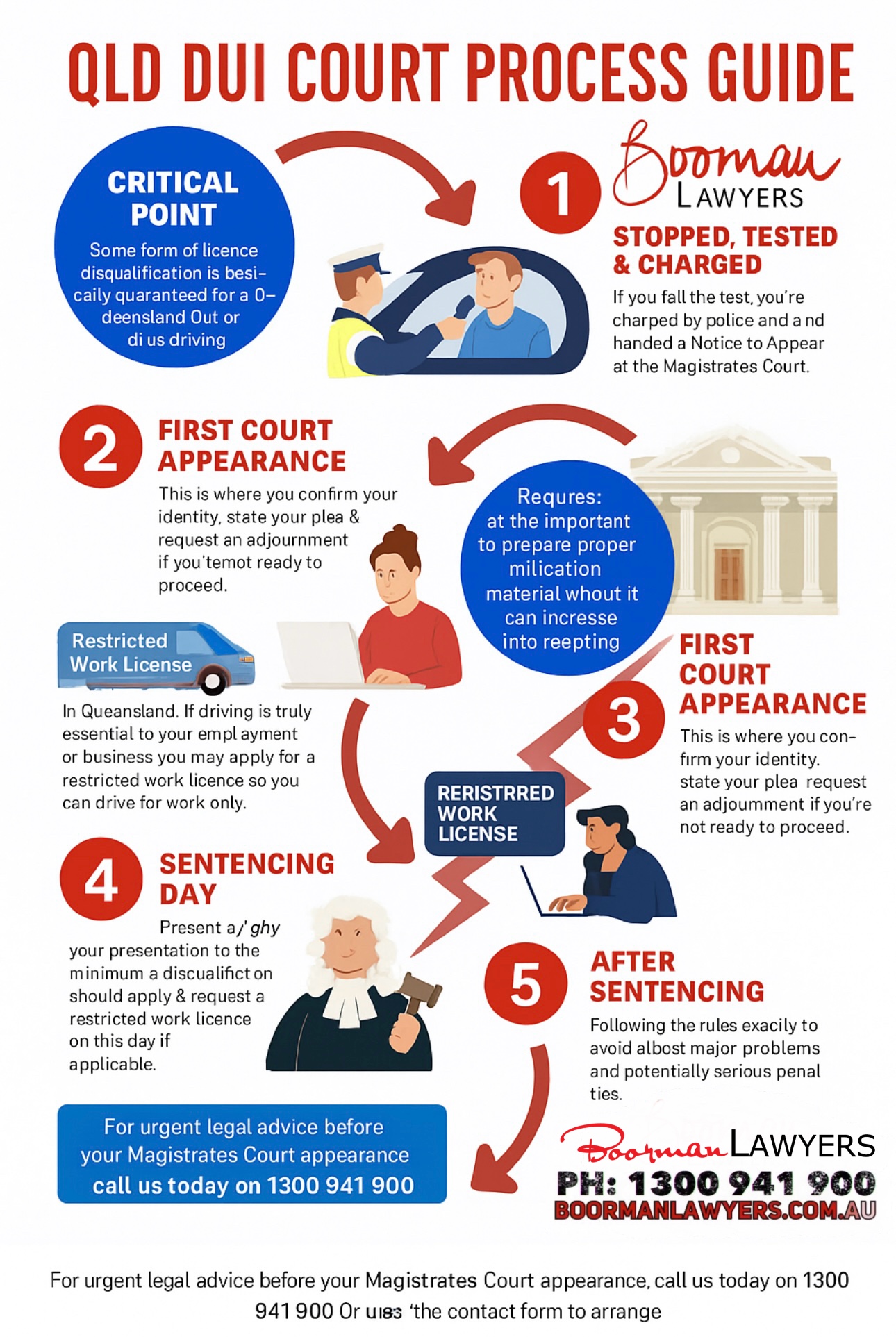
For a DUI or drug driving offence in Queensland, some form of licence disqualification is basically guaranteed if you’re convicted. The real question is how long you’ll be off the road — and whether you can lawfully keep driving for work under a restricted work licence. That’s why preparation matters.
The earlier you speak with a traffic lawyer, the more time you have to organise references, counselling, apology letters, and work-related affidavits before sentencing. That material can directly influence how the Magistrate views you.
Quick Navigation
- Overview of the QLD DUI Court Process
- Step 1. You’re Stopped, Tested and Charged
- Step 2. Your First Court Appearance (First Mention)
- Step 3. Preparing for Sentencing
- The QLD Restricted Work Licence
- Step 4. Sentencing Day in the Magistrates Court
- Step 5. After Sentencing – What Happens Next?
- Step 6. Court Etiquette and Speaking to the Magistrate
- QLD vs NSW – Key Differences
- FAQs
- Talk to Boorman Lawyers
Overview: The Typical Queensland DUI / Drink Driving Court Timeline
Even though every case is different, most drink driving or drug driving charges in Queensland move through the same key stages. Understanding this timeline is the first step in taking control of your situation instead of just reacting.
| Stage | What Happens | Your Priority |
|---|---|---|
| Police Stop / Roadside Test | The police conduct an alcohol breath test or saliva / blood test for drugs. If you fail, you’re taken for an evidentiary test. | Stay calm and respectful. Do not argue roadside. Everything you say can appear in the QP9. |
| Charge & Notice to Appear | You’re formally charged and given paperwork telling you which Magistrates Court to attend and when. | Record the date, time and courthouse. Missing that court date can trigger a warrant. |
| First Mention | The Magistrate confirms the charge and your plea. You can plead guilty or not guilty. If you plead guilty and you’re prepared, you may be sentenced that day. | If you’re not prepared, ask (through your lawyer) for an adjournment to gather mitigation material. |
| Preparation for Sentencing | You gather references, remorse letter, counselling proof, employment evidence and work licence affidavits. | Show remorse, insight, and hardship with real evidence, not excuses. |
| Sentencing | The Magistrate imposes penalty, fine, mandatory licence disqualification, and decides on any restricted work licence. | Be respectful, honest and focused on how you’ll prevent this from happening again. |
| After Sentencing | Your disqualification (and any work-only driving permission) begins immediately unless stated otherwise. | Follow the order exactly. Driving outside allowed conditions is a fast way to make things worse. |
Step 1. You’re Stopped, Tested, Charged, and Given a Notice to Appear
Typically, it begins when police intercept your vehicle. This could be during a random breath test operation, after a crash, or because of the way you were driving. If you return a positive roadside test, police will conduct an evidentiary breath analysis on a calibrated device. If you are in hospital, a blood sample is often used as your evidentiary reading.
After confirming the reading, police decide the charge. You may be charged with low range drink driving, mid-range or high-range drink driving, or drug driving (for example “relevant drug present” or “under the influence of a drug”). You will usually be served with a Notice to Appear that lists the Magistrates Court, date, and time you must attend.
| Issue | How It Affects You |
|---|---|
| Immediate Suspension | For certain readings (especially mid-range and high-range alcohol, or driving under the influence), police can immediately suspend your licence. From that point you cannot drive at all unless you later receive a restricted work licence through the Court. |
| Bail Conditions | You may be placed on bail. You must comply with all bail conditions and you must attend court when required. Failing to appear can lead to further charges and a warrant. |
| Drug Driving | Drug driving matters (for example, “relevant drug present”) are also dealt with in the Magistrates Court and follow a process very similar to drink driving. |
Driving while suspended or disqualified in Queensland is taken extremely seriously. Repeat disqualified driving can lead to jail. Do not risk “just one quick trip.”
Step 2. Your First Magistrates Court Appearance (the “First Mention”)
Your first appearance is called a mention. It’s normally short. The Magistrate isn’t running a full hearing and there won’t usually be witnesses or contested evidence at this point. Instead, the Magistrate wants to confirm the charge, confirm your identity, and ask whether you’re pleading guilty or not guilty.
If you intend to plead guilty and you’re properly prepared, the Magistrate may finalise the matter that same day. But if you’re not prepared — maybe you haven’t gathered references yet or you need to get affidavits ready for a restricted work licence application — your lawyer can ask for an adjournment. That adjournment gives you time to prepare before sentencing.
| If You’re Ready on Day One | If You’re Not Ready on Day One |
|---|---|
| You can plead guilty and be sentenced immediately. | Your lawyer can ask the Magistrate to adjourn to a later date for sentencing. |
| You can present remorse letters, references, counselling proof, and work licence affidavits. | You get time to collect references, start counselling, and prepare hardship evidence for a work licence. |
| You may seek a restricted work licence at sentencing that same day (if you qualify). | You avoid being sentenced with no supporting documents, which could result in a harsher outcome. |
If you go to court without your own lawyer, you should ask to speak to the duty lawyer (where available). The duty lawyer can often:
- Explain the charge and possible penalty range.
- Help you understand whether you’re in a position to plead guilty that day.
- Request an adjournment on your behalf if you need time to prepare.
Some lower-level traffic matters in Queensland can be dealt with through an online guilty plea in limited situations. However, higher-range drink driving, drug driving, and any case where you’re hoping to apply for a restricted work licence will almost always require you or a lawyer to appear. You generally cannot “online plea” your way into a restricted work licence.
Step 3. Preparing for Sentencing: What the Court Wants to See
The period between your first mention and the sentencing date is extremely important. This is where you build the material that can help reduce your disqualification period and, if eligible, support your restricted work licence application. Magistrates in Queensland expect you to turn up prepared, respectful and remorseful — not shrugging and hoping for the best.
You should focus on three main goals:
- Show remorse and personal responsibility for the offence.
- Show steps you’ve already taken to prevent it happening again.
- Show genuine hardship if you lose your licence completely, especially work-related hardship.
Helpful material often includes:
- Remorse letter: A sincere apology addressed to the Court. Acknowledge the danger to the public. Avoid “I felt fine to drive.” Explain what you’ve learned and the changes you’ve made.
- Character references: Preferably from employers, supervisors or respected community members who can say this behaviour is out of character. The reference should confirm they know about the charge, not pretend it didn’t happen.
- Counselling / rehabilitation evidence: Proof that you’ve already started alcohol counselling, drug counselling or a safe-driving / traffic offender education program. This shows real insight.
- Employment and hardship evidence: Payslips, invoices, ABN records, letters from your employer. The Court wants to see that you actually need to drive for work and that losing your licence would cause serious financial harm — not just inconvenience.
- Affidavits for a restricted work licence: In Queensland, these usually must be filed for sentencing day. You don’t normally get a second shot later.
| Good Preparation Signals | Poor Preparation Signals |
|---|---|
| You admit fault and acknowledge risk to the public. | You minimise it (“I thought I was fine,” “I wasn’t that bad”). |
| You’ve started counselling or an education program. | You’ve done nothing except complain about being caught. |
| You produce evidence that driving is essential for your work and income. | You vaguely claim you “need the car” with no documents to back it up. |
| You arrive in court neat, polite and on time, with documents filed. | You arrive late, disorganised, and argumentative. |
The Queensland Restricted Work Licence (Driving for Work Only)
Queensland has a unique option that can allow certain eligible drivers to keep driving for work purposes even after a drink driving conviction. This is known as a restricted work licence. It’s not automatic. It’s not guaranteed. It does not let you drive for personal reasons. It’s a strictly limited exception that exists to prevent you from losing your job or your business if driving is essential.
To convince the Magistrate to grant a restricted work licence, you generally need to prove that:
- You held an open (not provisional) Queensland driver licence at the time of the offence.
- Your offence type and reading fall into an eligible category. Very high-range cases and certain aggravated cases may be excluded.
- Driving is genuinely essential for your work or business income, and there’s no reasonable alternative such as reassignment, public transport, or hiring a driver.
- You (and often your family) would suffer serious financial hardship if you’re not allowed to drive for work at all.
| What the Court Looks For | Evidence Commonly Provided |
|---|---|
| Proof that driving is essential to your employment. | Employer affidavit confirming you must drive as part of your role, and that you can’t just be moved to office duties. |
| Proof of financial hardship if you cannot drive for work. | Your affidavit explaining income, expenses, dependants, and why losing work would cause real hardship. |
| Proof of responsibility and insight. | Evidence you’ve taken steps to make sure this won’t happen again (counselling, changed drinking habits, transport planning). |
| Correct timing of the application. | Affidavits filed before or at sentencing. If you forget to apply at sentencing, you usually don’t get to come back later and ask. |
If the Magistrate grants a restricted work licence, they’ll usually impose strict conditions. These can include:
- You can only drive for work, not personal errands or social reasons.
- You may only drive during set hours or within specific areas.
- You may have to carry a copy of the order while driving.
- You may be required to maintain zero alcohol at all times while driving.
Step 4. Sentencing Day in the Queensland Magistrates Court
Sentencing day is when the Magistrate decides the actual penalty for your DUI or drug driving offence. This could happen at your first mention if you’re ready, or on a later date if your matter was adjourned so you could prepare.
Here’s how it usually runs:
- Your matter is called. You and your lawyer (if you have one) stand at the bar table.
- The police prosecutor gives the Magistrate the QP9 — this is the police court brief that sets out the alleged facts, your reading, and your driving history.
- Your lawyer confirms your guilty plea and makes submissions. These submissions explain who you are, what happened, what you’ve done since, and why the penalty should be on the lighter end of the range. If you’re applying for a restricted work licence, this is where your lawyer asks the Court to grant it and tenders the affidavits and supporting documents.
- The Magistrate may ask you direct questions — especially about what you’ve done to ensure this won’t happen again.
The Magistrate will then impose sentence. Usually that includes:
- Whether a conviction is recorded.
- A fine or other order.
- A mandatory licence disqualification period (the length can vary).
- Whether you’re granted a restricted work licence and, if so, the specific conditions you must follow.
Step 5. After Sentencing – What Happens Next?
Once sentence is handed down, it usually takes effect immediately unless the Court states otherwise. If you’ve been disqualified from driving, you must not drive. If you’ve been granted a restricted work licence, you can only drive in strict compliance with that order.
You may be told to go to the court registry to collect paperwork or sign documents. Before leaving the courthouse, make sure you understand:
- Exactly how long you are disqualified from normal driving.
- When that disqualification starts and ends.
- If you received a restricted work licence, the hours, areas and purposes you’re allowed to drive for work.
Jail is not common for a first-time low or mid-range reading, but Queensland courts do consider jail for high-range readings, for repeat offenders, and especially for people who keep driving while disqualified. The Court’s top concern is road safety for the public.
Step 6. Court Etiquette and How to Speak to the Magistrate
How you present yourself in the Queensland Magistrates Court absolutely affects credibility. Magistrates deal with DUI and drug driving every single day. They’re looking for signs of genuine remorse, insight, and respect for road safety.
Presentation matters
- Arrive early. Rushing in late creates a bad first impression.
- Dress neatly. You don’t need a suit, but you should look respectful and serious.
- Switch off your phone completely before court, not just to silent.
- Remove hats and sunglasses in court. Do not chew gum. Do not talk over anyone.
How to speak to the Magistrate
- Stand when you’re spoken to and address the Magistrate as “Your Honour.”
- Keep answers short, honest, and focused on responsibility, not excuses.
- Show that you understand drink or drug driving is dangerous to the public, not just “unlucky.”
- Explain what you’ve already changed — for example, “I’ve stopped drinking if I know I’ll need to drive the next day,” or “I’ve begun counselling.”
| Good Courtroom Behaviour | Bad Courtroom Behaviour |
|---|---|
| Polite tone, remorseful language, organised paperwork. | Eye rolling, interrupting, blaming police or bad luck. |
| Taking full responsibility and showing insight. | Minimising the risk or joking about it. |
| Explaining practical changes to prevent it happening again. | Claiming “I’ll be fine next time” with no real plan. |
QLD vs NSW – Key Differences You Need to Understand
Many people search online and read advice from interstate. That’s risky. Queensland and New South Wales deal with drink driving in different ways, especially when it comes to post-sentence driving options. You should always use QLD-specific advice if you’re being sentenced in Queensland.
| Issue | Queensland (QLD) | New South Wales (NSW) |
|---|---|---|
| Court | Magistrates Court handles DUI / drug driving charges. | Local Court handles drink driving matters. |
| Licence Disqualification | Licence disqualification is mandatory. The main debate is “how long,” not “if.” | Disqualification also applies, but NSW often relies on mandatory alcohol interlock devices for mid/high range and repeat cases to get drivers back on the road sooner. |
| Restricted Work Licence | QLD sometimes lets you apply for a restricted work licence, so you can keep driving strictly for employment. You usually must apply at sentencing and prove hardship. | NSW generally doesn’t offer a “work only” licence. Instead, a period with an interlock device is common for certain offences. |
| Preparation Focus | In QLD, you prepare affidavits for hardship and employment, plus remorse, counselling and safety planning. | In NSW, it’s common to complete a traffic offender intervention program before sentencing and present that completion to the Court. |
| Timing Pressure | If you miss the chance to apply for a restricted work licence at sentencing in QLD, you usually can’t come back later to ask for it. | In NSW, timing is about being ready to argue for leniency and interlock arrangements at sentencing. |
Bottom line: Don’t use NSW advice in a Queensland courtroom. The systems look similar on the surface but they’re not the same in practice, and misunderstanding that can cost you your licence or the chance at a restricted work licence.
For NSW-related traffic law information, you can refer to our NSW Traffic Law section which covers New South Wales processes separately.
Frequently Asked Questions
Do I have to go to court for a first-time low range drink driving charge?
In most cases, yes. When you’re charged with drink driving in Queensland, police will issue a Notice to Appear. That document requires you to attend the Magistrates Court on a specific date and time. Failing to attend can lead to a warrant and extra trouble. Some very minor traffic matters can sometimes be dealt with using an online guilty plea system, but drink driving is usually serious enough that the Court expects either you or a lawyer to appear.
If you’re hoping to seek leniency, reduce the disqualification period, or apply for a restricted work licence, you’ll almost certainly need to appear (personally or with a lawyer). The Magistrate will want to hear submissions about your remorse, your behaviour since the offence, and any genuine hardship you’ll suffer if you can’t drive at all.
What is a QP9 and why does it matter?
The QP9 is the police court brief used in Queensland DUI and traffic matters. It usually includes:
- The official version of events according to police.
- Your blood alcohol concentration or drug test result.
- Any admissions or statements the police say you made.
- Your traffic and criminal history.
The Magistrate reads the QP9 and relies on it during sentencing. That means you and your lawyer must review it in advance. If anything in the QP9 is factually wrong or unfairly worded, your lawyer can raise that with the prosecutor or clarify it to the Court. You don’t want to walk into sentencing blind to what the Police Summary says about you.
Can I keep driving for work after a DUI?
Potentially — but only under strict conditions and only if you qualify. Queensland allows some drivers to apply for a restricted work licence, which is a Court order letting you drive for work purposes only, during certain hours, within certain areas, and usually on a zero-alcohol requirement. This is meant to prevent you from losing your job or business entirely.
To get a restricted work licence, you generally need to show that you held an open Queensland licence at the time of the offence, that the charge falls into an eligible category, and that not being able to drive would cause genuine financial hardship — not just inconvenience. You also need affidavits (yours and often your employer’s) and supporting documents ready at the sentencing date. If you don’t apply at sentencing, you usually can’t come back later and ask for it.
If the Magistrate grants the order, you must follow every condition. Driving for personal errands instead of work, or outside the allowed hours, can get you charged again and may result in losing that restricted licence.
Talk to Boorman Lawyers Before You Go to Court
The most effective time to get legal help is before you stand up in front of the Magistrate. Proper preparation can shorten your disqualification period, improve how the Court sees your remorse, and, if you’re eligible, support a restricted work licence application that lets you keep driving for your job.
Boorman Lawyers regularly appears in Magistrates Courts across Queensland, including Brisbane, Southport, Beenleigh, Maroochydore, Townsville and Cairns. We help clients understand the QP9, organise supporting material, draft affidavits, and present sentencing submissions aimed at getting the best possible result.
To arrange confidential legal advice, call 1300 941 900 or get in touch via our Contact Page.
You can also read more about restricted driving options and hardship-style licences by visiting our page on the Special Hardship Licence in QLD.
For official Queensland Government guidance on drink driving limits, penalties and licence consequences, you can review the Queensland Government’s drink driving information here: Queensland Government – Drink Driving Laws.
Choose Your Qld Traffic Law Topic
Expert legal guidance for all QLD traffic law matters

Drink Driving Offences

Drink Driving Penalties

Drink Driving Defences

Drug Driving Offences & Penalties

DUI Restricted Work Licence

Special Hardship Order

Alcohol Interlock Laws
Avoid a Conviction for DUI

Courts We Attend

Traffic Law Costs

Traffic Law FAQs

Traffic Offenders Program

Why Choose Us?

QLD Court Process

Other Traffic Offences

DUI Videos
Why Choose Boorman Lawyers?
Experienced legal professionals committed to achieving the best outcomes for our clients
Specialist Expertise
Dedicated focus on traffic law and DUI cases with proven results
24/7 Availability
Immediate legal assistance when you need it most
Proven Track Record
89% success rate in DUI cases with hundreds of Section 10 dismissals
Personalized Service
One-on-one attention and customized legal strategies for your case
Transparent Pricing
Clear, upfront legal costs with no hidden fees
Multi-Location Access
Convenient offices in Brisbane, Gold Coast, and Sydney
Real Court Cases, Real Results
Watch exclusive behind-the-scenes footage and case studies from actual DUI court proceedings across NSW and QLD










Client Success Stories
See what our clients have to say about their experience with Boorman Lawyers
My expectations were exceeded, with my representation by Boorman Lawyers. Especially Mr Josh Boorman. Your advice and help far surpassed the goal. Your kindness, respectfulness, and Integrity, went the extra mile.
Dan
Facebook Review
I'm so glad I did! I was granted a section 10 which was the best possible outcome in my case. Josh was extremely patient, helpful and professional. He was always there to go through any questions or concerns I had.
Rosemary
Google Reviews
The most professional people, provided full ongoing support, they brought me the best outcome in court, despite my very serious matter. JOSH not only looks after his clients on a professional aspect but also aids in breaking up the personal stress and trauma the client is in.
Shubham
Google Reviews
I would highly recommend Boorman Lawyers. Josh was the perfect example as to why you should get a lawyer, right from the start he took the stress away, had all paperwork and advice needed spot on, even down to the finer details that can affect an outcome.
Dave
Google Reviews
Both Josh and Matt were efficient, professional and very knowledgeable. They kept me updated and made a very stressful situation a lot easier. Would highly recommend to anyone. Thank you so much.
Bianca
Google Reviews
Great service and affordable pricing. Always available to take my calls and answer all my questions. Will definitely use them again if I ever need a lawyer. Highly recommend!
Michelle
Google Reviews
I was very pleased with the result I got from Boorman Lawyers. Josh made me feel very comfortable and explained everything well. He was very easy to talk to and got me the best possible outcome.
Sarah
Google Reviews
My expectations were exceeded, with my representation by Boorman Lawyers. Especially Mr Josh Boorman. Your advice and help far surpassed the goal. Your kindness, respectfulness, and Integrity, went the extra mile.
Dan
Facebook Review
I'm so glad I did! I was granted a section 10 which was the best possible outcome in my case. Josh was extremely patient, helpful and professional. He was always there to go through any questions or concerns I had.
Rosemary
Google Reviews
The most professional people, provided full ongoing support, they brought me the best outcome in court, despite my very serious matter. JOSH not only looks after his clients on a professional aspect but also aids in breaking up the personal stress and trauma the client is in.
Shubham
Google Reviews
I would highly recommend Boorman Lawyers. Josh was the perfect example as to why you should get a lawyer, right from the start he took the stress away, had all paperwork and advice needed spot on, even down to the finer details that can affect an outcome.
Dave
Google Reviews
Both Josh and Matt were efficient, professional and very knowledgeable. They kept me updated and made a very stressful situation a lot easier. Would highly recommend to anyone. Thank you so much.
Bianca
Google Reviews
Great service and affordable pricing. Always available to take my calls and answer all my questions. Will definitely use them again if I ever need a lawyer. Highly recommend!
Michelle
Google Reviews
I was very pleased with the result I got from Boorman Lawyers. Josh made me feel very comfortable and explained everything well. He was very easy to talk to and got me the best possible outcome.
Sarah
Google Reviews
Ready to Fight Your Case?
Get expert legal advice from experienced professionals - Call now for immediate assistance
 Contact Us Now
Our Locations
Brisbane, QLD 4000
Gold Coast, QLD 4217
Sydney, NSW 2000
We attend all courthouses in QLD & NSW
Office Hours
Monday - Friday:
8:30am - 6:00pm
Saturday - Sunday:
Closed
Immediate Assistance
Call now for urgent legal matters. We're here to help when you need us most.
Boorman Lawyers Pty Ltd - Ph: 1300 941 900
OFFICE MEETING BY APPOINTMENT ONLY - Mail to: PO Box 7065 GCMC QLD 9726
© 2016-2025 - BoormanLawyers.com.au - All Rights Reserved
Liability limited by a scheme approved under professional standards legislation. Legal practitioners employed by Boorman Lawyers Pty Ltd are members of the scheme.
The information published on this webpage should not be taken as legal advice rather it should be considered for information purposes only. Boorman Lawyers accept no responsibility or liability for the use of information, material or external resources provided for on this webpage.