
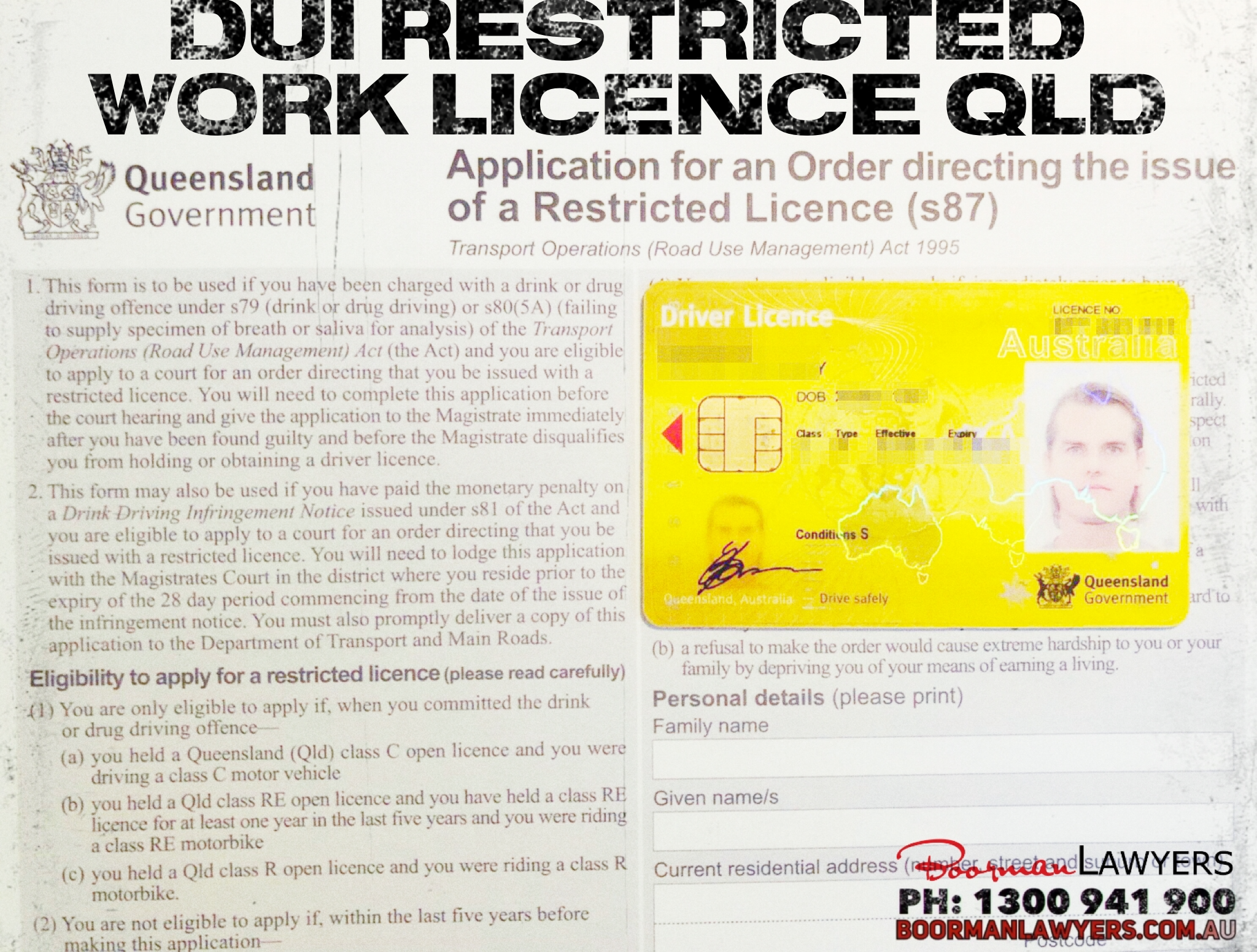
Queensland is currently the only state in Australia that still allows certain drivers charged with drink driving or drug driving offences to apply for a Restricted Work Licence (often called a DUI Work Licence). This special licence lets an eligible person continue driving for work purposes only, even while they’re otherwise disqualified from holding a normal Queensland driver licence.
If you rely on your licence to keep your job, support your family, travel for work duties, attend job sites, or operate a work vehicle, the difference between getting a Restricted Work Licence and losing your licence entirely can be life-changing. Our Queensland Traffic Lawyers at Boorman Lawyers regularly act for clients seeking a Section 87 Work Licence in Magistrates Courts across Queensland.
Below we explain what a DUI Work Licence is, who can apply, the strict legal tests that must be satisfied, and the detailed step-by-step process to follow in Court. We’ll also outline why preparation is critical, what evidence the Magistrate expects, and how we help clients present the most persuasive case possible.
What Is a DUI Work Licence in Queensland?
A DUI Work Licence (also known as a Restricted Work Licence or Section 87 Licence) is a Court Order made by a Magistrate that lets you keep driving in a very limited, highly controlled way if you’ve been charged with certain lower-level drink driving or drug driving offences. The licence is not automatic. It’s considered a privilege, not a right.
The order will usually restrict:
- When you can drive (allowed days and times);
- Why you can drive (work-related purposes only);
- What vehicle(s) you can drive (e.g. company vehicle, class of licence);
- Whether you must carry a certified copy of the Court Order whenever you drive.
If you breach any of those limits, you can lose the work licence immediately and face further penalties for driving in breach of Court-imposed conditions.
Why Does a Work Licence Matter?
For many people, driving is essential to keeping a job. Tradespeople need to attend sites, sales reps travel between clients, contractors cover large areas with no meaningful public transport, and shift workers start before buses even run. If you can’t drive, you often can’t work — and if you can’t work, the Court may consider that you’ll suffer severe financial hardship. That hardship, and your reliability as a driver moving forward, sits at the heart of a Section 87 application.
It’s not uncommon for people to assume that “the Magistrate will understand and just give me one.” That’s not how it works. The Court must apply very specific legislation, consider high road-safety standards, and weigh up community risk. You have to convince the Magistrate.
Watch: How to Get a DUI Work Licence in QLD
Which Law Covers Restricted Work Licences?
The law that allows a Magistrates Court to grant a Restricted Work Licence comes from Section 87 of the Transport Operations (Road Use Management) Act 1995 (TORUM). Section 87 sets out who is eligible, what needs to be proven, and how the Court may structure the order if it is granted.
It’s important to note that this is a Queensland-specific law. Other Australian states and territories generally do not offer this type of restricted driving privilege after a drink driving charge. Queensland is unique in still providing a pathway for eligible offenders to keep working.
Who Is Eligible to Apply for a DUI Work Licence?
Not everyone is eligible. The eligibility rules are strict and, in some cases, unforgiving. Broadly, to apply for a Restricted Work Licence you must be able to show that you:
- Hold a current Queensland provisional or open licence (you cannot apply if you’re unlicensed, suspended for other reasons, or disqualified already);
- Were charged with a “lower level” drink driving offence — typically not high-range, not a very serious aggravated driving scenario;
- Recorded a Blood Alcohol Concentration (BAC) of below 0.15% at the time of the offence;
- Were not driving to or from work at the time (if you were literally on the way to work, that can disqualify you from applying);
- Were not already driving under a work licence or a zero-alcohol licence condition at the time of the offence;
- Have not, within the previous 5 years, been convicted of drink driving, drug driving, dangerous driving or had your licence disqualified/suspended for similar major traffic matters;
- Can prove that losing your licence will cause extreme financial hardship to you or your family (for example, you’d lose your job or your business cannot operate without you driving).
If you do not meet those threshold requirements under Section 87 TORUM, you will generally be deemed ineligible and the Court will not consider an application, no matter how much hardship you’re facing.
Two Critical Things You Must Prove
Assuming you are eligible, that’s only the first hurdle. The Court then has to be persuaded on two major points before it will even think about granting a work licence:
- You are a fit and proper person to hold a Restricted Work Licence; and
- You (or your family) will suffer severe financial hardship if you can’t drive for work.
“Fit and proper” doesn’t mean perfect. It means the Court needs to be confident you understand the seriousness of the offence, that you’re taking responsibility, that you are unlikely to reoffend, and that you are capable of following strict driving limitations without posing an ongoing risk to the public. If your behaviour was particularly dangerous, reckless, or involved other aggravating features (crash, speeding, other offences), it becomes harder to satisfy this requirement.
“Severe financial hardship” needs to be spelled out with evidence. It’s not enough to say “this will be annoying” or “this will make things tight for a while.” The Court expects a clear, practical explanation of why you absolutely need to drive for work purposes to keep income coming in — for example, that you will be dismissed from your job without a licence, that you can’t relocate to a site you can walk to, or that you are the only income earner in your household.
The Court Process: Step-by-Step
Below is how a typical Section 87 Work Licence Application proceeds in Queensland.
Step 1: First Court Mention
When you are charged, you’ll receive a Notice to Appear at a Queensland Magistrates Court. At that first listing (often called the “first mention”), it is absolutely critical that you (or your lawyer) inform the Magistrate that you intend to apply for a Restricted Work Licence under Section 87. If the Court decides to convict and disqualify you immediately — before you raise this — it will usually be too late to go back and apply later. Timing is everything here.
Step 2: Adjournment for Application Preparation
If you raise the issue properly, the Court will usually adjourn (postpone) the sentencing and allocate a future date specifically to hear your Work Licence Application. That gives you time to prepare, file, and serve the necessary documents.
Step 3: Preparing the Application Form
There is a formal Section 87 Restricted Work Licence Application Form which you obtain from the Magistrates Court Registry. This form has to be completed accurately and filed with the Court. A copy of that form also needs to be served on Police Prosecutions — typically at least 1–2 weeks before the application date. If you miss that deadline, Police can (and often will) object to your application being heard.
Step 4: Affidavit from You (the Defendant)
You must prepare and file a detailed affidavit. This affidavit should cover (among other things):
- Your employment situation (job title, duties, hours, locations you drive to);
- Your financial circumstances (income, debts, dependants, mortgage/rent obligations);
- Why you need to drive for work rather than using taxis, rideshare, public transport or colleagues;
- The likely consequences for you and your family if you cannot drive (for example, termination of employment or closure of your sole trader business);
- Your remorse, insight, and any steps you’ve taken since the offence to address the behaviour (traffic offender programs, counselling, alcohol awareness programs, etc.);
- Why you believe you are a fit and proper person to be granted a Restricted Work Licence.
This is formal sworn evidence. It must be witnessed, signed, and truthful. If you lie or exaggerate, you may be cross-examined and exposed — which can destroy your credibility in front of the Magistrate and potentially lead to more serious consequences.
Step 5: Employer’s Affidavit (If You’re Not Self-Employed)
If you work for someone else (you’re an employee, not self-employed), your employer will also usually need to provide an affidavit. The employer’s affidavit commonly confirms:
- That driving is an essential part of your job duties;
- That there are no practical alternatives if you lose your licence (e.g. no other driver available, no viable public transport);
- That you’re at genuine risk of losing your job if you cannot drive; and
- That the employer supports you continuing employment under a restricted licence with conditions from the Court.
This affidavit can make or break the application. Magistrates take it seriously because it shows whether granting the work licence serves a real, lawful business need — or whether you’re simply asking for leniency.
Step 6: Filing and Serving All Material
Your application form, your affidavit, and (if relevant) your employer’s affidavit must be:
- Filed with the Magistrates Court where your matter is being heard; and
- Served on the Police Prosecutor within the required time frame, normally 1–2 weeks prior to the hearing.
Once filed, the Court will seal (stamp) the documents and provide copies to you. Serve those copies on Police Prosecutions immediately. Do not leave service to the last minute.
Step 7: The Hearing of the Work Licence Application
On the allocated date, you will return to Court for your Work Licence Application to be formally argued. The Magistrate will consider:
- Your traffic history and criminal history;
- Your BAC (or alleged drug reading) at the time of the offence;
- Any aggravating features, like dangerous driving, crash involvement, or passengers at risk;
- Your level of insight and remorse;
- Evidence of hardship and employability;
- Any objections raised by Police Prosecutions.
If satisfied, the Magistrate may grant a Restricted Work Licence Order under Section 87, setting out the exact terms under which you’re allowed to drive. If not satisfied, the application can be refused — and there is often very little you can do after the refusal.
What Conditions Can the Magistrate Impose?
If your application is approved, expect strict limits. Typical conditions include:
| Condition Type | What It Usually Means in Practice |
|---|---|
| Purpose of Driving | You may only drive for work purposes (not personal errands, social trips, school drop-offs, etc.). |
| Hours / Days | Your licence may only apply during certain hours or days of the week that match your employment needs. |
| Vehicle Limitation | You may be restricted to driving only a company vehicle or certain classes of vehicle (e.g. no heavy vehicle). |
| Carry Order | You may have to carry a certified copy of the Court Order whenever driving and present it if stopped by police. |
It’s critical that you comply 100%. If you’re caught breaching conditions — for example, using the Restricted Work Licence to drive to a social event — the Court can cancel the order, disqualify you further, and you may even face additional charges.
Can You Appeal If the Magistrate Refuses?
In most cases, the Court’s refusal to grant a Section 87 Work Licence is effectively final for that offence. You do not get multiple attempts. That’s why it’s so important to present a careful, well-prepared, and honest application the first time — ideally with representation from a lawyer experienced in Queensland drink driving and drug driving matters.
Why Use an Experienced Queensland Traffic Lawyer?
A Section 87 application is partly legal, partly evidence, and partly persuasion. The Magistrate needs to be confident that:
- you understand how serious your conduct was;
- you won’t repeat it;
- the community won’t be exposed to risk if you’re allowed to keep driving for work; and
- without a restricted licence, your income (and possibly your family’s stability) will be seriously damaged.
That’s what we do. Boorman Lawyers appear daily in Queensland Magistrates Courts on traffic and DUI matters. We know what evidence the Court expects, how different Magistrates approach Section 87 applications, and how to present your situation in a way that addresses the Court’s concerns under the legislation.
Contact Our QLD DUI Work Licence Lawyers
If you’ve been charged with drink driving or drug driving in Queensland, you must act quickly — especially before your first court date. If you intend to seek a Restricted Work Licence, that intention needs to be made clear to the Magistrate before you are sentenced.
To protect your livelihood and give yourself the best chance of keeping limited driving privileges for work purposes, contact our team today.
Boorman Lawyers – Traffic Law
Phone: 1300 941 900
Enquiries: Contact Boorman Lawyers
More information: Drink Driving Offences in QLD
DUI Work Licence QLD – Frequently Asked Questions
Can anyone charged with drink driving apply for a work licence?
No. You must meet the strict eligibility criteria in Section 87 of the TORUM Act. If your BAC was 0.15% or higher, or you were already on a zero-alcohol or restricted licence, you are generally not eligible.
Will I automatically get a restricted work licence if I apply?
No. The Magistrate has full discretion. You must prove you are a fit and proper person and that refusing the licence would cause severe financial hardship for you or your family.
Do I need to tell the Court at my first mention if I want a work licence?
Yes. If you don’t tell the Court at your first appearance that you intend to apply for a Section 87 Restricted Work Licence, and the Magistrate decides to sentence you immediately, it’s usually too late to apply afterward.
What happens if I drive outside the terms of my restricted licence?
You can lose the work licence, face further disqualification, and be charged again. The conditions imposed by the Court are enforceable and closely monitored.
Do I really need a lawyer for a Section 87 application?
It’s not legally mandatory, but in practice it’s extremely helpful. A properly prepared application — with clear affidavits, supporting employer evidence, and persuasive submissions — can make the difference between keeping your job or losing your licence completely.










 Contact Us Now