
First Time Drink Driving Penalties in QLD: A Complete Guide
In shortFor a first Queensland drink driving offence committed on or after 31 August 2026, the court must disqualify you for 2 months (low range) up to at least 6 months (0.15 or more). Maximum fines run from 20 penalty units ($3,454) to 40 penalty units ($6,908). This guide explains the ranges, work licences and interlock.
- Penalties: first-offence maximum fines of $3,454 to $6,908 and disqualification from 2 months to at least 6 months (offences from 31 August 2026).
- Work licence: possibly available for eligible low and mid range drivers on an open licence; not for 0.15 or more.
- Interlock: required after mid range, under the influence, failing to provide a specimen and some repeat offences.
Queensland law · law checked 22 Oct 2026
This article was written before Queensland drink and drug driving penalties changed on 31 August 2026 (with further changes from 1 December 2026), so the penalties discussed here may not reflect current law.
What's on this page
This guide covers drink driving under the Transport Operations (Road Use Management) Act 1995 (TORUM). It was first published on 10 August 2025 and its penalty figures were updated on 22 October 2026 for offences committed on or after 31 August 2026 (see the dated note at the end).
In Queensland, a first time drink driving offence carries a mandatory licence disqualification: for offences on or after 31 August 2026, from 2 months (low range) up to at least 6 months (high range or under the influence). Maximum fines for a first offence range from 20 penalty units ($3,454) to 40 penalty units ($6,908), with a maximum of 3 to 9 months' imprisonment depending on the reading. A section 87 work licence may be available to some eligible low and mid range drivers on an open licence. It is not available for 0.15 or more. The offences are in TORUM s 79; disqualification periods are in s 86.
Table of Contents
- What Counts as Drink Driving in Queensland
- BAC Categories: Low, Mid and High Range Explained
- The No Alcohol Limit — Who It Applies To
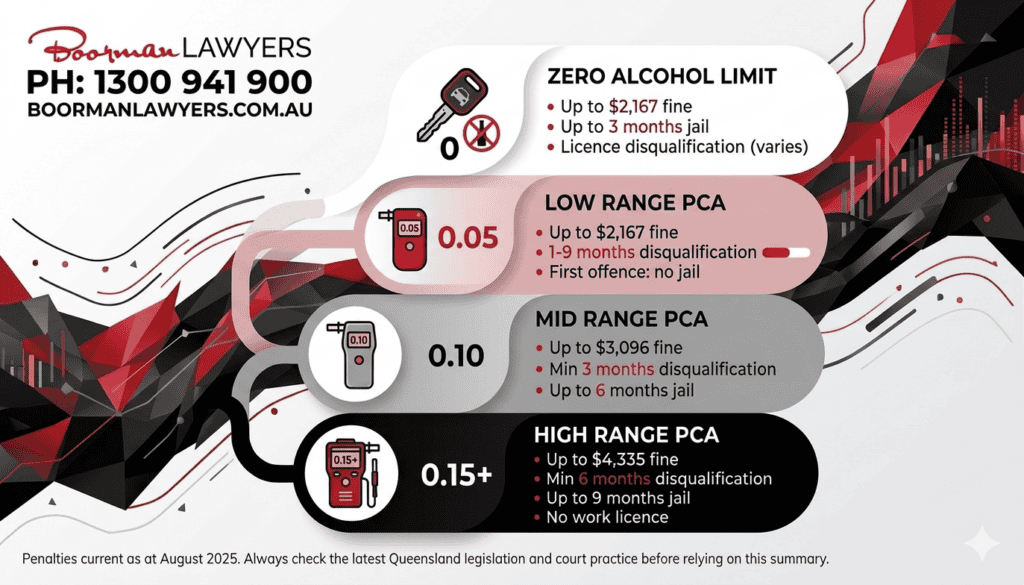
- First Offence Penalty Table
- What Happens Immediately After Being Charged
- What Happens at the Magistrates Court
- Mitigating Factors That Can Reduce Your Penalty
- Section 87 Work Licence — Full Breakdown
- Alcohol Ignition Interlock Program
- Impact on Your Criminal and Traffic Record
- How a DUI Lawyer Can Help
- FAQs — Queensland Drink Driving
What Counts as Drink Driving in Queensland?
Drink driving in Queensland is a criminal traffic offence prosecuted under section 79 of the Transport Operations (Road Use Management) Act 1995 (Qld) — commonly known as TORUM. The offence is committed when a person drives, attempts to drive, or is in charge of a motor vehicle on a road or road-related area while their Blood Alcohol Concentration (BAC) exceeds the applicable legal limit for their licence type.
Queensland law does not require proof that you were actually impaired by alcohol. The offence is established solely by the BAC reading. If your reading is at or above the relevant threshold, the offence is made out — regardless of how you were driving, how many drinks you had, or how long ago you consumed them.
A motor vehicle for the purposes of TORUM includes cars, motorcycles, trucks, buses, and certain other powered vehicles. It does not include bicycles or most motorised recreational devices. The offence applies on any road or road-related area — which is broadly defined and includes car parks open to the public, private driveways accessible to the public, and the like.
Important: You can be charged with drink driving even if your vehicle is stationary — for example, if you are sitting in the driver’s seat with the engine running or the key in the ignition. The law uses the phrase “in charge of” a motor vehicle, which is interpreted broadly by Queensland courts.
BAC Categories: Low, Mid and High Range Explained
Queensland’s drink driving offences are divided into three principal categories based on your Blood Alcohol Concentration reading. Each category carries different mandatory minimum disqualification periods and different maximum penalties.
Low Range (0.05 to 0.099)
A low range reading means your BAC was at least 0.05 but below 0.10. This is the most common drink driving offence in Queensland. Many people charged at this range genuinely believed they were under the limit — particularly those who consumed what they considered to be a moderate amount of alcohol and waited before driving. The science does not always align with that expectation: individual BAC is affected by body weight, sex, food consumption, rate of drinking, and other metabolic factors.
At this range, a first offence carries a maximum of 20 penalty units ($3,454) or 3 months' imprisonment, and a disqualification of 2 to 9 months for offences on or after 31 August 2026 (it was 1 to 9 months before then). Imprisonment is rare for a first low range offence, but the mandatory disqualification and fine are real consequences with significant practical and professional impacts. Since the 2026 changes, an eligible first-time low range driver on an open Queensland licence may be offered an infringement notice instead of a court charge; see our Queensland drink driving penalties page.
Mid Range (0.10 to 0.149)
A mid range reading means your BAC was at least 0.10 but below 0.15. This is treated more seriously. First-time mid range offenders face a maximum of 28 penalty units ($4,835) or 6 months' imprisonment, a disqualification of 3 to 12 months, and an immediate licence suspension from the time they are charged. The court has the power to impose imprisonment, though this is uncommon for genuine first offenders who present well-prepared mitigation. The most important practical concern at mid range is eligibility for a Section 87 work licence, which can remain available at this range for an eligible first offender on an open licence. A mid range offence also brings the interlock program when you return to driving.
High Range (0.15 and above)
A high range reading is the most serious category. A BAC of 0.15 or above is conclusively presumed to be driving under the influence (s 79(1), (3)). For a first offence it carries a maximum of 40 penalty units ($6,908) or 9 months' imprisonment and a disqualification of at least 6 months. Critically, high range drink driving is excluded from eligibility for a Section 87 restricted work licence — meaning if you are convicted at this range, the court cannot grant you a licence to drive for work purposes, regardless of your circumstances. An alcohol ignition interlock is also required before you can be fully re-licensed.
The No Alcohol Limit — Who It Applies To
Not all Queensland drivers are held to the general 0.05 limit. Queensland does not have a 0.02 limit; instead, some drivers must have no alcohol at all in their breath or blood (the "no alcohol limit"). It applies to:
- learner, provisional and probationary licence holders, and unlicensed drivers (s 79(2A));
- drivers of particular vehicles, including trucks, buses, articulated vehicles, B-doubles, road trains, vehicles carrying placarded dangerous goods, tow trucks, taxis, limousines and booked hire vehicles, driver trainers, specially constructed vehicles and tractors (s 79(2B)–(2D));
- restricted (work) licence holders, people driving under a section 79E special hardship order, and drivers subject to an interlock condition (s 79(2J)).
If you hold a learner or P-plate licence and return any positive reading, even 0.01, you are committing an offence. For a first offence, the maximum is 20 penalty units ($3,454) or 3 months' imprisonment, with a disqualification of 3 to 9 months for learner, provisional, probationary and unlicensed drivers, or 1 to 9 months for drivers of particular vehicles. Restricted licence, section 79E and interlock drivers face a higher maximum of 26 penalty units ($4,490) or 6 months (s 79(2J)).
First Offence Penalty Table — Queensland Drink Driving (TORUM s 79)
The table below sets out the maximum penalties and the disqualification ranges for a first offence committed on or after 31 August 2026. Courts have discretion within these ranges and take into account all relevant circumstances, and actual penalties vary. Penalty unit values are indexed on 1 July each year; from 1 July 2026 one penalty unit is $172.70 (Queensland Government), so the dollar figures below are as at 22 October 2026.
| Offence category | BAC reading | Maximum fine | Maximum imprisonment | Disqualification | Work licence possible? |
|---|---|---|---|---|---|
| No alcohol limit (learner, P, probationary, unlicensed) | Over 0.00 | 20 penalty units ($3,454) | 3 months | 3 to 9 months | No |
| No alcohol limit (particular vehicles) | Over 0.00 | 20 penalty units ($3,454) | 3 months | 1 to 9 months | No |
| General alcohol limit ("low range") | 0.05 to under 0.10 | 20 penalty units ($3,454) | 3 months | 2 to 9 months | Possibly, if eligible |
| Middle alcohol limit ("mid range") | 0.10 to under 0.15 | 28 penalty units ($4,835) | 6 months | 3 to 12 months | Possibly, if eligible |
| Under the influence, including 0.15 or more | 0.15 and above, or affected | 40 penalty units ($6,908) | 9 months | At least 6 months | No |
Source: TORUM ss 79 and 86, and the Department of Transport and Main Roads first-offence table (TMR, last updated 31 August 2026). For offences committed before 31 August 2026, lower maximum fines and shorter minimum disqualifications applied. Further changes start on 1 December 2026; see our Queensland drink driving offences guide for the current position. This table is a general guide only and does not constitute legal advice.
Second and Subsequent Offence Penalties
If you have a prior drink or drug driving conviction within the preceding 5 years , you are treated as a second or subsequent offender under TORUM. This means higher maximum fines (TMR lists a maximum of $12,434 for a repeat offence), longer disqualification periods, and a substantially increased risk of imprisonment. A repeat under the influence offence carries an automatic disqualification of 1 year (2 years with more than one prior), and repeat lower-range offences carry 3 to 18 months (TORUM s 86). TMR states that your car may be impounded for a repeat offence with a reading of 0.15 or more or a failure to provide a specimen.
What Happens Immediately After Being Charged?
Understanding what happens from the moment of the breath test through to your court date is important for managing the process effectively.
The Breath Test Process
When police conduct a roadside breath test (preliminary breath test or PBT), the device provides an indicative result. If that result indicates a reading at or above 0.05 — or if you are a zero-limit driver and any reading is returned — you will be required to submit to an evidentiary breath test at a police station using a more accurate device called a breath analysis instrument. It is the breath analysis reading, not the roadside reading, that is used as the formal BAC figure in court proceedings.
If you are physically unable to provide a breath sample — due to a medical condition, for example — police may require a blood sample instead. Failing to provide a specimen for analysis is taken to be an offence of driving under the influence (s 80(11)) and carries the same penalties as under the influence, including immediate suspension and the interlock program.
Immediate Licence Suspension
For mid range and high range (under the influence) charges, and for failing to provide a specimen, your Queensland driver licence is immediately suspended when you are charged — before you ever appear in court (s 79B). This immediate suspension continues until the charge is dealt with, withdrawn or discontinued. For a low range charge, a 24-hour suspension applies, and an immediate suspension applies only in certain circumstances, for example if another drink driving charge is still pending (TMR).
If your licence is immediately suspended, you cannot lawfully drive — at all — during the suspension period. Driving on a suspended licence is a separate and serious offence.
Notice to Appear / Charge
After processing, you will typically be given a Notice to Appear at the Magistrates Court, or in some cases a written charge or summons. The Notice will specify your court date, the court location, and the charge you are facing. Keep this document — missing your court date without a lawful excuse can result in an arrest warrant being issued.
Vehicle Sanctions
For a repeat drink driving offence with a reading of 0.15 or more, or a failure to provide a specimen, TMR states that your car may be impounded. Impoundment periods and the rules for later offences are set by law and can change, so check the current rules with your lawyer.
What Happens at the Magistrates Court?
Drink driving matters in Queensland are heard in the Magistrates Court. The court at which your matter will be heard is typically the court nearest to where the offence occurred or nearest to your place of residence, depending on the charge. In Queensland, drink driving is not dealt with in the District or Supreme Court unless it involves a serious associated offence (such as death or grievous bodily harm caused by driving).
Guilty Plea — The Most Common Approach
The vast majority of drink driving matters in Queensland are resolved by a guilty plea. This is because the evidentiary breath analysis reading is almost always conclusive proof of the offence — challenging the technical validity of the result requires specific grounds and careful legal analysis. For most people, a guilty plea — entered at the earliest opportunity — is the most practical course of action.
Pleading guilty at the first available opportunity typically results in a discount on the severity of the penalty imposed by the Magistrate. Courts in Queensland are expressly able to take into account the utilitarian value of an early guilty plea — meaning the earlier you indicate a guilty plea, the more credit you receive.
Contesting the Charge
In limited circumstances, there may be grounds to challenge a drink driving charge. These include challenges to the accuracy or proper operation of the breath analysis instrument, procedural non-compliance by police (such as failure to administer the breath test within the required timeframe after driving), or the identity of the driver. These defences require careful analysis by an experienced DUI lawyer and are not available in most cases. If you believe there is a technical ground to contest your charge, obtain legal advice promptly — before your first court date.
What the Magistrate Considers
When imposing a penalty for a drink driving offence, a Magistrate in Queensland will take into account:
- Your BAC reading and the specific range of the offence
- Whether this is a first or subsequent offence
- The circumstances of the offending (were you in traffic? Was there an accident?)
- Whether you entered an early guilty plea
- Your personal circumstances, employment, and financial situation
- Whether you have completed a relevant traffic offender program
- Character references and evidence of remorse
- Any other matters relevant to the nature and severity of the offence
The Magistrate must impose at least the mandatory minimum disqualification — that cannot be avoided. However, everything above the minimum is within the court’s discretion, which is why proper preparation and representation makes a material difference to the outcome you receive.
Mitigating Factors That Can Reduce Your Penalty
While the mandatory minimum disqualification cannot be avoided, there is significant scope for the court to exercise discretion — imposing the minimum disqualification rather than a longer period, reducing or moderating the fine, or taking a less punitive approach overall. The following are the most effective mitigating factors in Queensland drink driving matters.
Traffic Offender Programs
A traffic offender program is an educational course that many Queensland drink driving offenders complete before sentence. Completing a program before your court date, rather than waiting to be ordered, can show the court that you acknowledge the seriousness of your conduct, and courts can treat it as a concrete indicator of insight rather than just words. See our guide to traffic offender programs in Queensland.
Genuine Remorse and Insight
Courts are experienced in distinguishing genuine remorse from performative apology. A letter of apology or affidavit that thoughtfully addresses what happened, why it was wrong, and what steps you have taken to ensure it does not happen again carries real weight. A lawyer can help you frame this appropriately without inadvertently undermining your position.
Character References
References from employers, colleagues, community members, or family who can speak to your character — and who are aware of the charge — provide independent evidence of your standing and reputation. The reference should acknowledge the offence, confirm that it is out of character, and attest to the writer’s view of your honesty and reliability.
First Offence Status
A clean or relatively clean prior traffic history is a significant mitigating factor. Courts treat first offenders materially differently from repeat offenders, and the absence of any prior drink driving history is always noted.
Circumstances of the Offending
The specific circumstances matter. A reading of 0.052 on an otherwise empty road after a quiet dinner is treated differently from a reading of 0.149 driving erratically past a school. Presenting a clear, honest account of the circumstances — without minimising or excuse-making — helps the court contextualise the moral culpability involved.
Personal Hardship
Where the offender is experiencing genuine financial hardship, employment difficulty, or other significant personal circumstances, courts can and do take these into account — particularly when considering the quantum of any fine and the appropriateness of the disqualification period within the available range.
Section 87 Work Licence — Full Breakdown
One of the most important and frequently asked-about aspects of a Queensland drink driving matter is the Section 87 restricted work licence — formally a restricted licence ordered by the court under section 87 of the Transport Operations (Road Use Management) Act 1995.
What Is a Section 87 Work Licence?
A Section 87 work licence is a court order that allows a person who has been convicted of certain drink driving offences to drive — on a restricted basis — during their disqualification period, for the purposes of their employment. It is not a full licence. It restricts you to driving for work-related purposes only, typically between specified locations and during specified hours.
Who Is Eligible?
You must be convicted of an offence under s 79 or s 80(5A) and be disqualified as a result (s 87(1)). In summary, the court must not grant the application if (s 87(5)):
- the offence was under the influence, including a reading of 0.15 or more, or a no alcohol limit offence;
- you were a learner, P-plate, probationary, unlicensed or restricted licence driver, or driving a vehicle that requires a zero reading;
- you did not hold a Queensland provisional or open licence at the time of the offence;
- your licence was suspended or cancelled, or you were disqualified, within the previous 5 years (with some exceptions);
- you were convicted of drink or drug driving, or dangerous driving, within the previous 5 years;
- you committed the offence while doing something directly connected with earning your living; or
- you were already on a restricted licence.
If you are eligible, you must satisfy the court that you are a fit and proper person to hold a restricted licence and that refusal would cause extreme hardship to you or your family by depriving you of your means of earning a living (s 87(5)(a)). Failing to provide a specimen is not covered, and there is no work licence for a low range infringement notice disqualification.
⚠️ A reading of 0.15 or more is excluded from section 87 eligibility. If your BAC was 0.15 or above, you cannot apply for a work licence regardless of how much you need your licence for work. This is a statutory exclusion under TORUM.
What the Court Requires
A Section 87 application requires careful preparation. The court will require:
- Your affidavit — sworn statement setting out your personal circumstances, employment details, financial situation, why you need to drive, the circumstances of the offence, your remorse and insight, and your traffic history
- Your employer’s affidavit — sworn statement from your direct supervisor or employer confirming your employment, the driving requirements of your role, why public transport or other alternatives are not viable, and the consequences for the business if you cannot drive
- The completed court application form
- Your current Queensland traffic history (obtained from the Department of Transport and Main Roads)
- Evidence that you have completed or are enrolled in a traffic offender program, if you have done one
Timing — This Is Critical
A section 87 application must be made at the sentencing hearing, before the court disqualifies you (s 87(2)). Once you are convicted and your licence is disqualified, you cannot go back and apply for a work licence retrospectively. This means you need to have your affidavits prepared and your application ready before your first court appearance, or as a priority immediately after your first appearance if the matter is adjourned.
If you appear unrepresented and enter a guilty plea without applying for a work licence at the same time, you will lose the opportunity to do so. This is one of the most common — and most costly — mistakes people make when attempting to handle a drink driving matter without legal advice.
What Happens if the Application Is Granted?
If the court grants your Section 87 application, it will impose conditions on your restricted licence — typically specifying the hours during which you can drive, the locations between which you can drive, and the vehicle(s) you are permitted to drive. These conditions are strict. Driving outside the terms of your restricted work licence is a criminal offence and will result in immediate disqualification and prosecution for a separate offence.
What Factors Does the Court Consider?
The Magistrate will consider whether you genuinely need the licence for work (not just that it would be convenient), whether alternatives such as public transport or help from others are realistic, the consequences of losing your income for you and any dependants, and whether you are a fit and proper person to hold a restricted licence given the circumstances of the offence. A well-prepared application — with clear, credible affidavits that address each of these matters honestly — significantly increases the likelihood of the application being granted.
Learn more on our QLD DUI work licence page, or contact our team to discuss your eligibility.
Alcohol Ignition Interlock Program
Queensland operates an alcohol ignition interlock program under Part 3B of TORUM, administered by the Department of Transport and Main Roads (TMR). An interlock is a breath-testing device fitted to your vehicle that prevents it from starting if alcohol is detected. See our Queensland alcohol interlock guide for more detail.
Who Must Participate?
The interlock program applies after a conviction for (TORUM s 91I):
- a middle range offence (0.10 to under 0.15);
- under the influence, including a reading of 0.15 or more;
- failing to provide a specimen;
- dangerous driving while affected by alcohol; or
- a repeat lower-range drink driving offence within 5 years.
How the Program Works
When your disqualification ends and you get a new licence, it carries an interlock condition (an "I" on your licence). You must then complete a prescribed period of 12 months holding a licence with the interlock condition (s 91K). The period can be extended if the interlock records a breach, such as a failed start test, tampering, a missed service or driving a vehicle without the interlock. While you are an interlock driver you are also on a zero alcohol limit (s 79(2J)). If you never complete the prescribed period, the interlock period ends 5 years after it started, and until then you cannot lawfully drive without the interlock.
Cost of the Interlock
The alcohol ignition interlock is not provided free by the government; you pay for installation, servicing and removal. Interlock costs are set by the approved providers and can change, so check current costs with an approved provider and the TMR interlock information before you plan. This is an additional cost on top of any fines, legal costs, and the indirect costs of being off the road during the disqualification period.
For first-time low range offenders, who are not usually required to take part in the interlock program, this cost does not apply. That is another reason why the distinction between ranges matters so much in practice.
Impact on Your Criminal and Traffic Record
Traffic History
A drink driving conviction is recorded on your Queensland traffic history permanently. This record is maintained by the Department of Transport and Main Roads and is separate from your criminal history. Your traffic history is used by courts for sentencing in subsequent traffic matters, and is also accessed by insurers, some employers, and licensing authorities.
For sentencing purposes, a prior drink or drug driving conviction within the preceding 5 years makes you a repeat offender. This is calculated from the date of the previous conviction (not the date of the previous offence), so the timing of your court date can, in some circumstances, affect which category of offender you fall into.
Criminal History
Whether a Queensland drink driving conviction appears on your criminal history depends on how the offence was dealt with by the court. Where a fine is imposed under the Penalties and Sentences Act 1992 without a conviction being recorded — which is sometimes possible for minor first offences under a good behaviour order — the impact on your criminal history may be reduced. However, the vast majority of drink driving matters before the Magistrates Court result in a formal conviction being recorded.
Under the Criminal Law (Rehabilitation of Offenders) Act 1986 (Qld) , certain convictions can become “spent” after a rehabilitation period. For an adult where no imprisonment was ordered, the rehabilitation period is generally 5 years. Once spent, the conviction need not be disclosed in many contexts — but important exceptions apply, including for certain professional licensing, working with children checks, and police checks for specific purposes.
Impact on Employment and Licensing
A drink driving conviction can affect employment in regulated industries — particularly those requiring a professional licence, security clearance, or working with vulnerable persons. If you hold a professional licence in a regulated field (healthcare, law, finance, teaching, construction), you should obtain specific advice about your disclosure obligations following a drink driving conviction.
How a Queensland DUI Lawyer Can Help
Many people assume a guilty plea to drink driving means there is nothing a lawyer can do. That assumption is incorrect — and in many cases, it results in people receiving significantly worse outcomes than they needed to.
An experienced Queensland DUI lawyer can assist you in the following practical ways:
- Assess technical defences: In some cases, there are legitimate grounds to challenge the charge — including issues with the breath analysis procedure, the device itself, or the legal requirements for the test. These issues require careful and prompt assessment.
- Optimise your guilty plea: A well-presented guilty plea — supported by QTOP completion, a credible and appropriately framed letter of remorse, and strong character references — can make a material difference to the penalty imposed within the court’s discretionary range.
- Prepare your Section 87 work licence application: This is perhaps the single most important area where legal representation pays dividends. The affidavits must be carefully drafted to address all the legal criteria. An application that fails to satisfy the court on any of those criteria will be refused — and the opportunity cannot be revisited after the fact.
- Identify the right court date strategy: In some circumstances, the timing of your plea can affect which sentencing category you fall into (for example, where a 5-year anniversary of a prior conviction is approaching). A lawyer will identify these issues and advise accordingly.
- Represent you before the Magistrate: Effective advocacy at the sentencing hearing — presenting your mitigation clearly and responding to any concerns the Magistrate raises — is a skill that comes from experience. The Magistrate’s impression of you as a person, not just the paper file in front of them, matters.
- Google review by Neal Singh.
“This man has gone above and beyond the past few years for me and has a genuine care for people. The work he does is a reflection of his character. Cannot thank you enough. You are the best at what you do.”
Neal Singh (opens full review in a new tab) - Google review by Noah Southcombe.
“Josh did a great job and got the work liscense across the line - highly recommend.”
Noah Southcombe (opens full review in a new tab) - Google review by Rhonda Smith.
“I just wanted to say a massive Thank You to Joshua I was very happy and relieved at such a great outcome.It was a really stressful time leading up to the case and Joshua had the time and patience to literally walk me through the process …”
Rhonda Smith (opens full review in a new tab) - Google review by Tony Dempsey.
“Glad I went with Josh - got a much better than expected outcome and would definitely recommend!”
Tony Dempsey (opens full review in a new tab) - Google review by Ilenna J.
“I cannot recommend Boorman Lawyers highly enough. From the moment I engaged them, they guided me through the process with patience, professionalism, and genuine compassion. Even though I was entering a standard guilty plea, they took the …”
Ilenna J (opens full review in a new tab) - Google review by Daniel Elstone.
“Josh’s services were exceptional. Highly knowledgeable and a good down to earth person who was easy to talk to, which helped immensely during an experience that is not the norm myself. …”
Daniel Elstone (opens full review in a new tab) - Google review by Serah Phillips.
“⭐️⭐️⭐️⭐️⭐️ My journey with Boorman Lawyers, and especially Josh, was a meeting point of …”
Serah Phillips (opens full review in a new tab) - Google review by Tom George.
“Thankyou to Mr Josh Boorman for being a professional and a very competent lawyer to get me through a tricky Dui charge.I am full of gratitude and admiration for Mr boorman representing me and I would definitely recommend him and his team to …”
Tom George (opens full review in a new tab) - Google review by Tom93.
“I was facing a high-range DUI and had no idea what to expect. Josh was calm, clear, and supportive from day one. He walked me through everything, always honest and never judgmental. …”
Tom93 (opens full review in a new tab) - Google review by Lozz Fountain.
“I would highly recommend Josh Boorman for any legal representation required. Josh took time to understand my situation thoroughly and offered clear, practical and honest advice that helped me make informed decisions. …”
Lozz Fountain (opens full review in a new tab) - Google review by Deran hal.
“I had an excellent experience with josh boorman. He was professional, knowledgeable, and truly cared about my case. From start to finish, josh boorman communicated clearly and kept me informed every step of the way. His expertise and …”
Deran hal (opens full review in a new tab) - Google review by Hamish Alger.
“Josh and the team at Boorman law were so professional & caring that I would recommend them to anyone. Besides the unbelievable outcome he was just so caring & invested. Thank you Josh. You are a truely good at what you do. Thank thank thank you.”
Hamish Alger (opens full review in a new tab) - Google review by The Dude.
“Thank you Joshua Boorman for representing me in court. I received an incredible outcome and am forever thankful for your diligence and care. I can continue my life with joy. A lot of life lessons learnt. Can't thank you enough Sir.”
The Dude (opens full review in a new tab) - Google review by Ignatius Cirttenden.
“Don't let his man bun deceive you, Joshua Boorman is a master of the art of law fare. Not only does he have a dashing smile and gives the warmest hugs, Joshua is a magnificent representative and should be a first resort for legal issues.”
Ignatius Cirttenden (opens full review in a new tab) - Google review by Mark Dijakovic.
“It was an excellent service and I actually got stuck I couldn't get a medical and he helped me organize a medical in time for the court date, I highly recommend using borman lawyers it was a great service couldn't be any better”
Mark Dijakovic (opens full review in a new tab) - Google review by Thomas.
“Josh has been an excellent lawyer. Understanding my issue and taking time to help me. My problem was solved very smoothly.”
Thomas (opens full review in a new tab) - Google review by Amgalan Garmaev.
“Great professional job!”
Amgalan Garmaev (opens full review in a new tab) - Google review by Jake Astwood.
“Josh is awesome to work with. Doesn’t mess about. Gives you solid advice and then delivers where it counts the most. In the court room. Down to earth and professional to a tee. Thanks Josh you went above and beyond and delivered an outcome far and above what was expected.”
Jake Astwood (opens full review in a new tab) - Google review by Ribal Hosn.
“Readily available, clear communication, easy process! Extremely appreciative to Josh, we achieved the best outcome in court and it was such a smooth experience, highly recommended!!”
Ribal Hosn (opens full review in a new tab) - Google review by Michael.
“Josh was fantastic! Very professional and got me a great outcome. Would highly recommend”
Michael (opens full review in a new tab) - Google review by Wes M.
“Excellent firm, Josh did a fantastic job handing my case. Highly recommend !!”
Wes M (opens full review in a new tab) - Google review by badrinathravikanti.
“Success is guaranteed,Highly recommended .”
badrinathravikanti (opens full review in a new tab) - Google review by Laurence Mead.
“Josh recently lead my DUI incident and I can only say great things about how Josh conducted himself throughout the whole process. Josh's down to earth demeanour but professional approach kept me calm knowing …”
Laurence Mead (opens full review in a new tab) - Google review by David Forbes.
“Top bloke, great outcome. highly recommend”
David Forbes (opens full review in a new tab) - Google review by Eric Dickings.
“Honestly the best outcome i could have ever asked for, Thank you so much for all the help and advice. Absolute legend, i appreciate all the extra effort put in to help me out.”
Eric Dickings (opens full review in a new tab) - Google review by Bianca Debono.
“Mr Boorman is such a friendly and caring lawyer, he put so much time into my case and really was worth more money for his outstanding effort. He helped me to achieve an outcome I never expected; I got away with a 9-month good-behaviour bond …”
Bianca Debono (opens full review in a new tab) - Google review by Shanelle “Shanece” X.
“Highly recommended is an understatement!!! I was looking at another prison sentence for another high range DuI as I have bad traffic and criminal history and had been to prison in the past,this time I …”
Shanelle “Shanece” X (opens full review in a new tab) - Google review by Andee.
“Professional & nice service. He made everything clear from the beginning and was able to be contacted easily anytime. 5 stars! …”
Andee (opens full review in a new tab) - Google review by Conor Walters.
“I walked out of court with a much better result than I ever thought! Josh did so well and made everything super simple and easy! I was extremely scared but Ive walked out feeling a lot better! I would recommend to anyone and everyone! Worth every cent, I felt very supported!”
Conor Walters (opens full review in a new tab) - Google review by Chris Orpin.
“Best decision I could have made contacting Josh beyond a shadow of a doubt! I was looking at certain incarceration without representation, and Josh did exactly that......REPRESENT …”
Chris Orpin (opens full review in a new tab) - Google review by stephen milward.
“A very helpful and professional service I received from Boorman Lawyers , I was very happy with the outcome they worked hard to get me , would highly recommend them to anyone. …”
stephen milward (opens full review in a new tab) - Google review by Erin Parker.
“Can not recommend Josh enough! My 4th drink driving offence without a licence and no interlock in the car and drink driving low range. I got $120 fine and 1 year suspension. He is wortg every cent. Such an amazing result. Very happy. He came highly recommended from a friend and I am so great full. Thank you Josh! …”
Erin Parker (opens full review in a new tab) - Google review by Jagraj Singh.
“Josh is very amazing and good sportive person . He is very friendly to chat he is very good lawyer how much I can say to him not enough I just say to thanks joshua thanks for helping me”
Jagraj Singh (opens full review in a new tab) - Google review by Ollie Watts.
“Joshua Boorman is an intelligent and well informed lawyer who genuinely cared about me and the situation I was in. It meant a lot to me to have Josh, Junior Counsel and Senior Counsel represent me to see my case through and get the best …”
Ollie Watts (opens full review in a new tab) - Google review by Cameron Woodvine.
“Josh boorman represented me today with a dui and drug possession charge. I got the best result i could have asked for with a no conviction or record for both charges and only one month of disqualified license with a 24/7 work license. Thank you so much josh”
Cameron Woodvine (opens full review in a new tab) - Google review by Tyana Hansen.
“Josh handled my Drink driving charge and delivered better than he promised. I got off extremely lightly. He was very easy to work with and quick to respond to all my ongoing questions. He made the whole process so easy and seamless and took a lot of stress off me on the day.”
Tyana Hansen (opens full review in a new tab) - Google review by X T.
“Thanks for the great outcome. Very pleased with the service. Thanks Josh !”
X T (opens full review in a new tab) - Google review by Reginald Ledimo.
“Highly recommend Joshua. He got the best possible outcome for me in my case. He was easy to talk to and made me not worry about the case as much.”
Reginald Ledimo (opens full review in a new tab) - Google review by Lin ZHANG.
“Very good and professional lawyer. The outcome is much better than I expected. I strongly recommend Josh if you need any legal assistance. Very thanks, Josh😊”
Lin ZHANG (opens full review in a new tab) - Google review by Karen Fisher.
“Josh is amazing, he helped my son and got a fantastic outcome. Josh took all the stress out of court and everything ran like clock work. I could not recommend Josh highly enough”
Karen Fisher (opens full review in a new tab) - Google review by Cameron Waters.
“Josh was fantastic to deal with. He was easy to contact and communicate with. He achieved an excellent outcome and I wouldn't hesitate to contact him again should I need any more legal assistance.”
Cameron Waters (opens full review in a new tab) - Google review by Alan Scott.
“Big Thanks to Josh for all the help with my recent court matter . Josh made a difficult time for myself stress free with all information and advice above and beyond what I expected !!. I totally recommend Josh Boorman for any court matter you may find yourself in . Cheers mate !!”
Alan Scott (opens full review in a new tab) - Google review by corey reid.
“Josh represented me for a DUI matter and with such short notice I couldn’t be more happier with the result , very helpful and highly recommend him”
corey reid (opens full review in a new tab) - Google review by piotr wojcik.
“Very recommended dude... To the point and genuine... This industry can full of promises. Josh is down to earth ...”
piotr wojcik (opens full review in a new tab) - Google review by Shubham modgil.
“The most professional people, provided full ongoing support, they bought me the best outcome in court,despite my very serious matter, i would highly recommend booreman lawyers for any of your matter. …”
Shubham modgil (opens full review in a new tab) - Google review by Emily Quarrell.
“Excellent. I would not hesitate to recommend Josh Boorman as a lawyer who will provide the best possible result for his clients. He has a deep understanding of law across NSW and Qld jurisdictions and goes above and beyond in extracting detailed information from his clients, and is a concise and effective advocate in court.”
Emily Quarrell (opens full review in a new tab) - Google review by david thompson.
“I would highly recommend Boorman Lawyers. Josh was the perfect example as to why you should get a lawyer, right from the start he took the stress away, had all paperwork and advice needed spot on, even down to the finer details that none of …”
david thompson (opens full review in a new tab) - Google review by Brad Phillips.
“Boorman lawyers gave me a better out come than I ever expected I would use him any time I have a problem from now on thanks again”
Brad Phillips (opens full review in a new tab) - Google review by Karl Rodgers.
“Josh was a great help throughout my experience. He was thorough and informative before, during and after my trial. If needed i would definitely trust boorman lawyers again and would definitely recommend Josh for anyone in need of legal aid.”
Karl Rodgers (opens full review in a new tab) - Google review by SJR.
“Josh is without doubt the most unpretentious, straight-up, genuine, knowledgeable solicitor I have ever dealt with. …”
SJR (opens full review in a new tab) - Google review by leon bourgeon.
“Good advice, it pays to tick all the boxes and do all you can to present your best self before the court. I would recommend to friends if they find themselves in the same situation as I was. Thank you”
leon bourgeon (opens full review in a new tab) - Google review by King Lit Leong.
“I have been extremely lucky to have Josh represent me in my court case. Josh is an exceptional lawyer, he is professional, patient, supportive, knowledgeable and a good listener. He was right beside me every step of the way, by providing …”
King Lit Leong (opens full review in a new tab) - Google review by Ross Williams.
“Great outcome and very professional. Took the weight off my shoulders. Definitely recommend.”
Ross Williams (opens full review in a new tab) - Google review by Jamania Harris.
“Represented me so well. Pricing is great. Made me feel very at ease! Thanks again Josh.”
Jamania Harris (opens full review in a new tab) - Google review by mike purser.
“Very happy with Boorman lawyers Josh was organised and professional which lead me to get the result i was after.”
mike purser (opens full review in a new tab) - Google review by Garry J.
“Josh went above and beyond for me, got the best result possible of a minimum sentence for high range DUI, couldn't reccomend him highly enough”
Garry J (opens full review in a new tab) - Google review by Brandon Pietsch.
“Awsome I got the outcome that I wanted explained everything very well and was very helpful with everything”
Brandon Pietsch (opens full review in a new tab) - Google review by Key Let.
“Great person. I received the outcome he promised me. Very truthful and takes his time to explain every details. I felt relaxed over the hall ordeal. I'm loving life!”
Key Let (opens full review in a new tab) - Google review by barun chhetri.
“Highly recommended……solicitor / lawyer Joshua Boorman in Australia Sydney. …… If the google showed 6 stars or more I would click all of them. …”
barun chhetri (opens full review in a new tab) - Google review by P Singh.
“HIGHLY RECOMMENDED!!!!!!!! Josh is the best lawyer in Sydney. I was charged with Mid range PCA but josh …”
P Singh (opens full review in a new tab) - Google review by Yatharth Donde.
“I had been charged with mid range PCA. I am extremely grateful for Josh for all his help and bearing with me through everything! Results from the magistrate were quite surprising I got no conviction, no disqualification and no fine. I really recommend Josh for all the Traffic offence charges.”
Yatharth Donde (opens full review in a new tab) - Google review by Andrew Dometaki.
“Josh worked hard to achieve a section 10 for me on a drink drive charge. So glad I decided to go with this awesome firm. Easy to work with and very professional. …”
Andrew Dometaki (opens full review in a new tab) - Google review by Charles Stewart.
“Josh represented me at Waverley court this morning and he delivered the desired result. He was professional, diligent and I felt like he really got me. …”
Charles Stewart (opens full review in a new tab) - Google review by kenny morgan.
“Josh represented me at my trial for a DUI charge in Sydney. I blew 0.119 being a Mid-Range offence. Josh had some of the Police material which was irrelevant to my case deleted prior to the hearing. He reviewed all my references & my letter …”
kenny morgan (opens full review in a new tab) - Google review by Bethany Mannion.
“Josh managed to get me a section 10 for a special range DUI charged in Sydney. Being from Canberra I could always message or call him about any questions I had. Great lawyer highly recommended him !”
Bethany Mannion (opens full review in a new tab) - Google review by Allan Provan.
“Positive outcome, thanks josh Worked hard for a section 10 in my low range ova case”
Allan Provan (opens full review in a new tab) - Google review by Darren Dowsett.
“As a first time low range PCA offender coupled with a speeding offence and first appearance before the court, my stress and anxiety levels were insurmountable. I engaged the help of Joshua from Boorman lawyers who represented myself in …”
Darren Dowsett (opens full review in a new tab) - Google review by Katie Eales.
“Joshua was a excellent lawyer who got me a section 10 for a low-range PCA. He was well prepared and helped me a lot with all my documents and gave me great advice. I highly recommend him.”
Katie Eales (opens full review in a new tab)
- Facebook review by Adam Webster.
“Josh was extremely professional, reliable and was able to get the best result possible. Highly recommended. 5 stars!”
Adam Webster (opens full review in a new tab) - Facebook review by Nicole Ray.
“Tegan was an absolute saviour for my business. With very little briefing she was able to turn my business processes into 6 sets of perfectly articulated terms and conditions to cover all of our needs. It has been integral in elevating my brand to a far more professional level, and I can sleep at night knowing that my agreements are legally sound. I couldn't recommend Tegan and Boorman Lawyers more highly. They are extremely professional, efficient and Tegan just understood exactly what I needed straight away and made it happen. Couldn't be happier with the service.”
Nicole Ray (opens full review in a new tab) - Facebook review by Melina Howe.
“Tegan was so helpful when filing our trademark application. She took the time to understand our business and was able to informally advise on some structuring aspects and influencer marketing tips, all of which previous lawyers I have been using failed to mention!”
Melina Howe (opens full review in a new tab) - Facebook review by Selena Evison.
“Awesome advice on the legal side of influencer marketing. Thank you Tegan🙏”
Selena Evison (opens full review in a new tab) - Facebook review by Heather Millar.
“Tegan Boorman has been our go-to commercial lawyer for my retail business, Kippins, for several years. She has helped us navigate challenging situations and always provided exceptional advice. Her knowledge of commercial law and her understanding of the needs of small businesses is second to none. Highly recommended!”
Heather Millar (opens full review in a new tab) - Facebook review by Bianca Grima.
“The best in the business 10/10”
Bianca Grima (opens full review in a new tab) - Facebook review by Chris Weston.
“Although I had a very good driving record and character references, a Section 10 can never be assumed. Josh Boorman worked with me to present a very strong case for my low range alcohol offence and I was acquitted with no fine, no suspension and no conviction. We spent a lot of time together writing and re-writing my references to get the wording perfect and also my explanation of how my offence came about. Josh has a lot of experience in this particular field and his thoroughness and presentation paid off successfully. A fixed fee agreed on before you start means you know exactly where you stand. Well done. Thanks again Josh.”
Chris Weston (opens full review in a new tab) - Facebook review by Singh Saab.
“5 stars”
Singh Saab (opens full review in a new tab) - Facebook review by Jessica Pantano.
“Josh was incredibly professional and sensitive to my traffic issue. He pushed for the best result possible and I got it! Would highly recommend for any traffic matter!”
Jessica Pantano (opens full review in a new tab) - Facebook review by Dave Thompson.
“I would highly recommend Boorman Lawyers. Josh was the perfect example as to why you should get a lawyer, right from the start he took the stress away, had all paperwork and advice needed spot on, even down to the finer details that none of us could've thought of that can effect an outcome.. Well done Josh and thank you for helping me get a positive outcome to keep my lively hood.”
Dave Thompson (opens full review in a new tab) - Facebook review by Monika Kundu.
“I was so lucky that josh was representing my case in the court .i was so terrified in the beginning but josh come up with such a absolute positive energy .i would highly recommend him to my friends and family .”
Monika Kundu (opens full review in a new tab) - Facebook review by Heidi Mcmillin.
“Simply brilliant and great to deal with. No hassle and great results.”
Heidi Mcmillin (opens full review in a new tab) - Facebook review by King Leong.
“I have been extremely lucky to have Josh represent me in my court case. Josh is an exceptional lawyer, he is professional, patient, supportive, knowledgeable and a good listener. He was right beside me every step of the way, by providing valueble advice and comforting assurance whenever I needed it. It is these qualities that truly differentiate him from the rest. My case definitely wasn't the easiest by any means. However, with Josh's skillful preparation of material and submission to the magistrate, he managed to get a great outcome for me. I highly recommend Josh to anyone who needs the best legal representation, and I can assure you won't regret it. Thank you Josh once again for your service. I hope I don't ever need your service again (touch wood), but if I do, you're the man.”
King Leong (opens full review in a new tab) - Facebook review by Andrew Ormsby.
“To any of my mates looking for lawyer that actually cares, knows his stuff and puts in 100% Joshua is the man.. You won't regret going to Joshua and you will get the best out come!”
Andrew Ormsby (opens full review in a new tab) - Facebook review by Craig Stewart.
“Thanks Joshua for the amazing outcome yesterday I'm still in a state of shock.. I would definitely recommend Boorman Lawyers to others. Can I just say Joshua is very professional in his approach in trying to achieve the desired outcome . Well prepared, briefed on the day & gave me confidence that I stood the best chance with Joshua representing me.”
Craig Stewart (opens full review in a new tab) - Facebook review by Jennifer Fernandes.
“Thanks Joshua for the good outcome. Would definitely recommend Boorman Lawyers to others. Very professional in his approach. Helped us to prepare all documents required. Also briefed us on the day. Gave us the confidence he was doing the best for us. And could see the difference between Boorman lawyers and others presenting. Will definitely recommend Boorman lawyers to others. Thanks again.”
Jennifer Fernandes (opens full review in a new tab) - Facebook review by Dan Gannon.
“A professional person in their time of indiscretion, needs a professional representation. My expectations where exceeded, with my representation by Boorman Lawyers. Especially Mr Josh Boorman. You're advice and help far surpassed the goal. You're kindness, respectfulness, and Integrity, went the extra mile, and far exceeded my expectations. I would recommend Mr Josh Boorman. For any legal matter you may have. Sincerely, Dan Gannon .”
Dan Gannon (opens full review in a new tab) - Facebook review by Jules Hannan.
“Fantastic, Boorman Lawyers - their team is extremely professional and they attend to their clients needs with courtesy and promptness. I would recommend Boorman Lawyers to anyone.”
Jules Hannan (opens full review in a new tab)
Queensland Drink Driving FAQs
What is the punishment for drink driving in Queensland?
Penalties depend on your BAC range, licence type and prior history under TORUM s 79. For a first offence committed on or after 31 August 2026: low range (0.05 to under 0.10) carries a maximum of 20 penalty units ($3,454) or 3 months and a 2 to 9 month disqualification; mid range (0.10 to under 0.15) carries 28 penalty units ($4,835) or 6 months and 3 to 12 months; and under the influence, including 0.15 or more, carries 40 penalty units ($6,908) or 9 months and at least 6 months. Mid range and above also bring the interlock program.
What is the minimum disqualification for first time drink driving in Queensland?
For offences on or after 31 August 2026, the minimum disqualification is 2 months for a first low range offence, 3 months for a first mid range offence, and 6 months for under the influence, including 0.15 or more (TORUM s 86). The minimums are set by statute and the court cannot go below them. For an offence before 31 August 2026, the low range minimum was 1 month.
Can I get a work licence after a drink driving charge in Queensland?
Possibly. An eligible first offender on an open Queensland licence convicted of low or mid range drink driving may apply for a section 87 restricted work licence. You must apply at the sentencing hearing, before you are disqualified, and satisfy the court that you are fit and proper and that refusal would cause extreme hardship by depriving you or your family of your means of earning a living. A reading of 0.15 or more is excluded. Preparation of the supporting affidavits and application is critical — a poorly prepared application will be refused.
What is the minimum fine for drink driving in Queensland?
For offences before 1 December 2026, courts set the fine according to the circumstances, up to the maximum. The maximum fine for a first low range offence is 20 penalty units ($3,454); for mid range it is 28 penalty units ($4,835); for under the influence, including 0.15 or more, it is 40 penalty units ($6,908). Further changes, including minimum fines, start on 1 December 2026, so check our current Queensland penalties page.
How long does a drink driving conviction stay on your record in Queensland?
A drink driving conviction is recorded permanently on your Queensland traffic history. For sentencing purposes, a prior drink or drug driving conviction within the preceding 5 years makes you a repeat offender with significantly higher penalties. The conviction may also appear on a criminal history check depending on how the matter was resolved and whether the spent convictions period has passed.
What BAC is over the limit in Queensland?
For open licence holders, a BAC of 0.05 or above is an offence. Learner drivers and P1/P2 provisional licence holders must have a BAC of 0.00 — any positive reading is an offence. Drivers of particular vehicles, such as trucks, buses, taxis and booked hire vehicles, are also on the no alcohol limit. Queensland does not have a 0.02 limit. The relevant limit depends on your licence and the vehicle you are driving.
Will I go to jail for first time drink driving in Queensland?
Imprisonment is possible but uncommon for a genuine first offender. The maximum for a first offence is 3 months' imprisonment for low range, 6 months for mid range and 9 months for under the influence, including 0.15 or more. Most first offenders with no aggravating features and good mitigation receive a non-custodial sentence, but every case turns on its own facts. Imprisonment is significantly more likely for repeat offenders at any range.
What is the difference between low range, mid range and high range drink driving in Queensland?
Low range is a BAC of 0.05 to under 0.10. Mid range is 0.10 to under 0.15. High range is 0.15 and above. The distinctions matter for penalty purposes — each range carries different mandatory minimum disqualification periods, different maximum fines, and different imprisonment thresholds. High range offenders are also excluded from section 87 work licence eligibility, and mid and high range offenders face the interlock program on re-licensing.
Does a criminal record clear after 7 years in Queensland?
Under the Criminal Law (Rehabilitation of Offenders) Act 1986 (Qld), certain convictions can become “spent” after a rehabilitation period — generally 5 years for an adult where no imprisonment was ordered. Once spent, the conviction does not need to be disclosed in most contexts. However, traffic convictions remain on your traffic history regardless of spent conviction status and continue to be relevant for sentencing in any subsequent traffic matter.
Does drink driving show on a police check in Queensland?
Drink driving convictions appear on your Queensland traffic history. Whether they appear on a National Police Check depends on the nature and outcome of the court proceedings. Where a formal conviction was recorded, it may appear on a criminal history check until the spent convictions period passes. For certain purposes — such as working with children, regulated employment, or security clearances — spent convictions may still be disclosed.
How far back does a police check go in Queensland?
A standard National Police Check will show all convictions that have not been spent under relevant legislation. Traffic history checks maintained by Queensland’s Department of Transport and Main Roads show your complete traffic history. For sentencing in a new drink driving matter, courts look back 5 years for the purpose of determining whether you are a first or repeat offender.
Is this August 2025 post still current?
First published August 2025. Check the dated notes here and the current Queensland guides before relying on it.
Facing a first drink driving charge in Queensland?
Your reading, your licence type and your history decide the penalty range, whether your licence is suspended now, and whether a work licence is possible. Get advice before your first court date, because a work licence application must be ready at sentence.
Our Queensland traffic law pages are kept current. Each case turns on its own facts, so treat this guide as general information, not legal advice. Call 1300 941 900 or make an enquiry about legal representation.
Law update since this post (checked 21 Oct 2026)
This post was first published on 10 August 2025. Because it is a general guide rather than a case report, its penalty figures were updated on 22 October 2026 instead of being kept as published.
- Queensland, 31 August 2026: Queensland drink and drug driving penalties changed for offences committed on or after 31 August 2026, with further changes from 1 December 2026. The original post used a penalty unit of about $154, a low range maximum of 14 penalty units, a 1-month low range minimum, a 28-unit maximum for high range and 'up to 18 months imprisonment'; those figures are replaced above with the current maxima ($172.70 per unit from 1 July 2026).
- Earlier errors corrected: the original referred to a 0.02 limit (Queensland has a no alcohol limit instead), 'exceptional hardship' (the test is extreme hardship), and interlock costs of $150 to $250 a month (costs are set by providers; check TMR).
Sources and date checked
Sources and references for this page, checked 22 Oct 2026.
- Original Boorman Lawyers post, published 10 August 2025 (read-only copy taken 21 Oct 2026) — checked 21 Oct 2026
- TMR – Drink driving penalties (first offence table, last updated 31 Aug 2026) — checked 22 Oct 2026
- Transport Operations (Road Use Management) Act 1995 (Qld) ss 79, 79B, 80, 86, 87, 91I, 91K — checked 22 Oct 2026
- Queensland Government – penalty unit value from 1 July 2026 — checked 22 Oct 2026
This page is general information about Queensland law only. It is not legal advice. Every matter turns on its own facts.
Choose your QLD traffic law topicQLD
Guides for Queensland traffic law matters.
Enquire about legal representation
Call 1300 941 900 or make an enquiry about legal representation.
What to have ready
- Court & next listing date: Which court is on your paperwork and when your matter is listed.
- Charge or reading (if known): Tell us the charge or reading if you have it — you do not need your full police facts yet.
- Work & driving needs: Let us know if you rely on your licence for work or family responsibilities.
Real court days, NSW & QLD
Behind-the-scenes footage and case discussions from court days across New South Wales and Queensland.
Visit Boorman Lawyers TV →
Find your court
Search for your courthouse to learn more about our legal services in your area.
Charged with a drink or drug driving offence?
Talk to us about legal representation for your court date.
Call 1300 941 900