
Drug Driving NSW: Cocaine Case - Reduced Penalties at Burwood
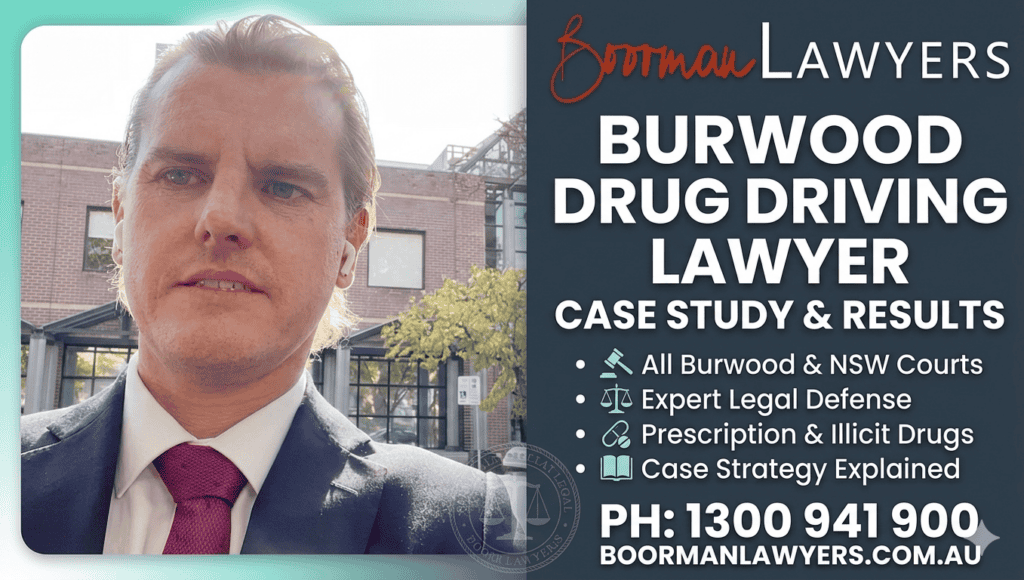
In shortJosh Boorman from Boorman Lawyers appeared at Burwood Local Court in Sydney’s inner west to represent a client charged with driving with an illicit drug — cocaine — present in his system. The circumstances were notable. Our client had consumed cocaine approximately 36 hours before the offence — two nights prior. He was not impaired at the time of driving.
- The Offence: Cocaine in System from 36 Hours Earlier
- Drug Driving NSW: How We Got Reduced Penalties at Burwood Local Court (Cocaine Case)
- The Default Penalties: What the Court Starts With
New South Wales law · law checked 21 Oct 2026
What's on this page
Case Study · NSW Local Court · By Joshua Boorman · Published 4 April 2026
⚖ Case Snapshot
Watch the video
| Jurisdiction | Burwood Local Court, NSW |
|---|---|
| Offence | Drive with illicit drug present — cocaine |
| Circumstances | Drug consumed ~36 hours prior; client not impaired |
| Prior Traffic History | No prior drink/drug driving; ~12 general entries over 6 years |
| Plea | Guilty |
| Outcome Sought | No conviction (CRO) — not granted due to criminal history |
| Result | 3-month disqualification + $600 fine (reduced from 6 months + $2,200) |
The Offence: Cocaine in System from 36 Hours Earlier
Josh Boorman from Boorman Lawyers appeared at Burwood Local Court in Sydney’s inner west to represent a client charged with driving with an illicit drug — cocaine — present in his system.
The circumstances were notable. Our client had consumed cocaine approximately 36 hours before the offence — two nights prior. He was not impaired at the time of driving. He was unexpectedly called into work early on a Saturday morning and, while travelling, was pulled over for a random breath test. He returned a negative result to alcohol. However, a mobile drug test returned a positive result for cocaine. A further sample was taken, sent to the police lab, and also returned positive.
This is one of the most important things to understand about drug driving law in NSW: you do not need to be impaired to be charged . The offence is simply having a detectable prescribed illicit drug present in your oral fluid or blood — regardless of when you consumed it or whether it affected your driving at all.
Drug Driving NSW: How We Got Reduced Penalties at Burwood Local Court (Cocaine Case)
Watch: Burwood Drug Driving Case — Full Video
Important: In NSW, drug driving is a strict liability offence. You can be convicted even if you consumed the drug days earlier and were completely unaffected at the time of driving. The presence of the drug in your system is sufficient.
The Default Penalties: What the Court Starts With
For a first offence of driving with an illicit drug present in NSW, the automatic starting point — what is called the automatic disqualification period — is 6 months off the road, plus a fine of $2,200.
However, the magistrate has discretion to reduce that disqualification to the minimum period of 3 months , and can also reduce the fine. Our goal was to persuade the magistrate to exercise that discretion in our client’s favour — and to push for a well-prepared outcome beyond that.
a well-prepared outcome: Conditional Release Order With No Conviction
In NSW, there is a particular outcome available called a Conditional Release Order (CRO) with no conviction recorded . If granted, this means no disqualification, no fine, and no conviction on the client’s record — typically replaced with a good behaviour bond.
The magistrate noted this is the outcome everyone appearing on drug driving charges wants — and rightly so. But as the court made clear, CROs without conviction are given out sparingly. They are reserved for cases where the circumstances are truly exceptional and the person’s broader record supports it.
Our submission was that the court could and should proceed on this basis. The offence itself was at the lowest possible end — the drug was consumed well before driving, the client was not impaired, and this was his first offence of this kind with no prior drink or drug driving history.
Why the No-Conviction Outcome Was Not Granted
Unfortunately, our client’s broader criminal record worked against him. While he had no prior drink or drug driving offences and no major traffic offences in the last five years, he did have approximately 12 entries on his criminal record over the preceding six years — with a notable cluster of around five entries in the most recent year alone, showing a progressively worsening pattern.
The magistrate could not look past that record when considering whether to grant a no-conviction outcome. Despite the strength of our submissions on the circumstances of the driving itself, the overall picture of the client’s conduct meant the magistrate felt a conviction was warranted.
Mitigation Strategy: What We Presented
Even where the right outcome is not achievable, proper mitigation can still make a significant difference to the penalty actually imposed. We presented the following to the court:
Traffic Offenders Program
Our client completed the Traffic Offenders Program before appearing at court. Completing this proactively — rather than waiting to be ordered — demonstrates genuine acknowledgment of the seriousness of the offence and is recognised by NSW courts as a meaningful step.
Character References
Our client disclosed the matter to his mother and his employer. Both provided letters of reference. These supported the picture of a person who had taken responsibility, been open about what happened, and was genuinely remorseful — not someone trying to minimise or conceal their conduct.
Letter of Apology
Our client prepared a personal letter of apology to the court. A genuine, well-crafted apology letter carries real weight — it gives the magistrate direct insight into the person’s mindset and level of remorse in a way that lawyer submissions alone cannot achieve.
Circumstances of the Offence
We emphasised the specific circumstances: the drug was consumed approximately 36 hours before driving, our client was not impaired, and he was called in to work unexpectedly. This was not a case of someone getting behind the wheel while affected — it was a residue detection case. That distinction matters to the court when assessing moral culpability.
The Result: Minimum Disqualification and Significantly Reduced Fine
✅ Outcome
3-Month Disqualification + $600 Fine
Reduced from the automatic 6-month disqualification and $2,200 fine. Conviction recorded.
While a conviction was recorded — which was not the outcome we ultimately sought — the magistrate exercised his discretion to reduce the disqualification from the automatic 6 months down to the minimum of 3 months , and reduced the fine from $2,200 down to $600 . That is a significant reduction in both penalty components.
Our client was pragmatic. Going in, he understood that getting straight back on the road and avoiding any penalty at all was going to be difficult given his record. It was still worth fighting for — and the mitigation we presented made a real difference to the outcome he walked away with.
Key Takeaways: Drug Driving in NSW
This case highlights several important principles for anyone facing a drug driving charge in NSW:
- Impairment is irrelevant to the charge. NSW drug driving is a presence offence, not an impairment offence. If cocaine — or any other prescribed illicit drug — is detected in your system, you can be convicted regardless of when you took it or how you were driving.
- A CRO with no conviction is possible but not assured. It is available in NSW for drug driving but reserved for the clearest cases. Your broader criminal and traffic record will be scrutinised — not just the offence itself.
- The magistrate has real discretion on penalty. The automatic 6-month disqualification and $2,200 fine are starting points, not fixed outcomes. With proper mitigation, the court can reduce both to the minimum.
- Proactive preparation matters. Completing the Traffic Offenders Program before court, obtaining strong references, and preparing a genuine apology letter all gave the magistrate tangible reasons to exercise discretion in our client’s favour.
- Your criminal record matters beyond traffic history. Even with no prior drug or drink driving offences, a broader criminal record — particularly a recent and worsening one — will significantly affect the court’s willingness to grant the most favourable outcomes.
Charged with drug driving in NSW?
com.au →
- Google review by Neal Singh.
“This man has gone above and beyond the past few years for me and has a genuine care for people. The work he does is a reflection of his character. Cannot thank you enough. You are the best at what you do.”
Neal Singh (opens full review in a new tab) - Google review by Rhonda Smith.
“I just wanted to say a massive Thank You to Joshua I was very happy and relieved at such a great outcome.It was a really stressful time leading up to the case and Joshua had the time and patience to literally walk me through the process …”
Rhonda Smith (opens full review in a new tab) - Google review by Tony Dempsey.
“Glad I went with Josh - got a much better than expected outcome and would definitely recommend!”
Tony Dempsey (opens full review in a new tab) - Google review by Ilenna J.
“I cannot recommend Boorman Lawyers highly enough. From the moment I engaged them, they guided me through the process with patience, professionalism, and genuine compassion. Even though I was entering a standard guilty plea, they took the …”
Ilenna J (opens full review in a new tab) - Google review by Daniel Elstone.
“Josh’s services were exceptional. Highly knowledgeable and a good down to earth person who was easy to talk to, which helped immensely during an experience that is not the norm myself. …”
Daniel Elstone (opens full review in a new tab) - Google review by Serah Phillips.
“⭐️⭐️⭐️⭐️⭐️ My journey with Boorman Lawyers, and especially Josh, was a meeting point of …”
Serah Phillips (opens full review in a new tab) - Google review by Tom George.
“Thankyou to Mr Josh Boorman for being a professional and a very competent lawyer to get me through a tricky Dui charge.I am full of gratitude and admiration for Mr boorman representing me and I would definitely recommend him and his team to …”
Tom George (opens full review in a new tab) - Google review by Tom93.
“I was facing a high-range DUI and had no idea what to expect. Josh was calm, clear, and supportive from day one. He walked me through everything, always honest and never judgmental. …”
Tom93 (opens full review in a new tab) - Google review by Lozz Fountain.
“I would highly recommend Josh Boorman for any legal representation required. Josh took time to understand my situation thoroughly and offered clear, practical and honest advice that helped me make informed decisions. …”
Lozz Fountain (opens full review in a new tab) - Google review by Deran hal.
“I had an excellent experience with josh boorman. He was professional, knowledgeable, and truly cared about my case. From start to finish, josh boorman communicated clearly and kept me informed every step of the way. His expertise and …”
Deran hal (opens full review in a new tab) - Google review by Hamish Alger.
“Josh and the team at Boorman law were so professional & caring that I would recommend them to anyone. Besides the unbelievable outcome he was just so caring & invested. Thank you Josh. You are a truely good at what you do. Thank thank thank you.”
Hamish Alger (opens full review in a new tab) - Google review by The Dude.
“Thank you Joshua Boorman for representing me in court. I received an incredible outcome and am forever thankful for your diligence and care. I can continue my life with joy. A lot of life lessons learnt. Can't thank you enough Sir.”
The Dude (opens full review in a new tab) - Google review by Ignatius Cirttenden.
“Don't let his man bun deceive you, Joshua Boorman is a master of the art of law fare. Not only does he have a dashing smile and gives the warmest hugs, Joshua is a magnificent representative and should be a first resort for legal issues.”
Ignatius Cirttenden (opens full review in a new tab) - Google review by Mark Dijakovic.
“It was an excellent service and I actually got stuck I couldn't get a medical and he helped me organize a medical in time for the court date, I highly recommend using borman lawyers it was a great service couldn't be any better”
Mark Dijakovic (opens full review in a new tab) - Google review by Thomas.
“Josh has been an excellent lawyer. Understanding my issue and taking time to help me. My problem was solved very smoothly.”
Thomas (opens full review in a new tab) - Google review by Amgalan Garmaev.
“Great professional job!”
Amgalan Garmaev (opens full review in a new tab) - Google review by barun chhetri.
“Highly recommended……solicitor / lawyer Joshua Boorman in Australia Sydney. …… If the google showed 6 stars or more I would click all of them. …”
barun chhetri (opens full review in a new tab) - Google review by P Singh.
“HIGHLY RECOMMENDED!!!!!!!! Josh is the best lawyer in Sydney. I was charged with Mid range PCA but josh …”
P Singh (opens full review in a new tab) - Google review by Jake Astwood.
“Josh is awesome to work with. Doesn’t mess about. Gives you solid advice and then delivers where it counts the most. In the court room. Down to earth and professional to a tee. Thanks Josh you went above and beyond and delivered an outcome far and above what was expected.”
Jake Astwood (opens full review in a new tab) - Google review by Yatharth Donde.
“I had been charged with mid range PCA. I am extremely grateful for Josh for all his help and bearing with me through everything! Results from the magistrate were quite surprising I got no conviction, no disqualification and no fine. I really recommend Josh for all the Traffic offence charges.”
Yatharth Donde (opens full review in a new tab) - Google review by Ribal Hosn.
“Readily available, clear communication, easy process! Extremely appreciative to Josh, we achieved the best outcome in court and it was such a smooth experience, highly recommended!!”
Ribal Hosn (opens full review in a new tab) - Google review by Michael.
“Josh was fantastic! Very professional and got me a great outcome. Would highly recommend”
Michael (opens full review in a new tab) - Google review by Wes M.
“Excellent firm, Josh did a fantastic job handing my case. Highly recommend !!”
Wes M (opens full review in a new tab) - Google review by badrinathravikanti.
“Success is guaranteed,Highly recommended .”
badrinathravikanti (opens full review in a new tab) - Google review by Laurence Mead.
“Josh recently lead my DUI incident and I can only say great things about how Josh conducted himself throughout the whole process. Josh's down to earth demeanour but professional approach kept me calm knowing …”
Laurence Mead (opens full review in a new tab) - Google review by David Forbes.
“Top bloke, great outcome. highly recommend”
David Forbes (opens full review in a new tab) - Google review by Eric Dickings.
“Honestly the best outcome i could have ever asked for, Thank you so much for all the help and advice. Absolute legend, i appreciate all the extra effort put in to help me out.”
Eric Dickings (opens full review in a new tab) - Google review by Bianca Debono.
“Mr Boorman is such a friendly and caring lawyer, he put so much time into my case and really was worth more money for his outstanding effort. He helped me to achieve an outcome I never expected; I got away with a 9-month good-behaviour bond …”
Bianca Debono (opens full review in a new tab) - Google review by Shanelle “Shanece” X.
“Highly recommended is an understatement!!! I was looking at another prison sentence for another high range DuI as I have bad traffic and criminal history and had been to prison in the past,this time I …”
Shanelle “Shanece” X (opens full review in a new tab) - Google review by Andee.
“Professional & nice service. He made everything clear from the beginning and was able to be contacted easily anytime. 5 stars! …”
Andee (opens full review in a new tab) - Google review by Conor Walters.
“I walked out of court with a much better result than I ever thought! Josh did so well and made everything super simple and easy! I was extremely scared but Ive walked out feeling a lot better! I would recommend to anyone and everyone! Worth every cent, I felt very supported!”
Conor Walters (opens full review in a new tab) - Google review by Chris Orpin.
“Best decision I could have made contacting Josh beyond a shadow of a doubt! I was looking at certain incarceration without representation, and Josh did exactly that......REPRESENT …”
Chris Orpin (opens full review in a new tab) - Google review by Andrew Dometaki.
“Josh worked hard to achieve a section 10 for me on a drink drive charge. So glad I decided to go with this awesome firm. Easy to work with and very professional. …”
Andrew Dometaki (opens full review in a new tab) - Google review by stephen milward.
“A very helpful and professional service I received from Boorman Lawyers , I was very happy with the outcome they worked hard to get me , would highly recommend them to anyone. …”
stephen milward (opens full review in a new tab) - Google review by Erin Parker.
“Can not recommend Josh enough! My 4th drink driving offence without a licence and no interlock in the car and drink driving low range. I got $120 fine and 1 year suspension. He is wortg every cent. Such an amazing result. Very happy. He came highly recommended from a friend and I am so great full. Thank you Josh! …”
Erin Parker (opens full review in a new tab) - Google review by Jagraj Singh.
“Josh is very amazing and good sportive person . He is very friendly to chat he is very good lawyer how much I can say to him not enough I just say to thanks joshua thanks for helping me”
Jagraj Singh (opens full review in a new tab) - Google review by Ollie Watts.
“Joshua Boorman is an intelligent and well informed lawyer who genuinely cared about me and the situation I was in. It meant a lot to me to have Josh, Junior Counsel and Senior Counsel represent me to see my case through and get the best …”
Ollie Watts (opens full review in a new tab) - Google review by Tyana Hansen.
“Josh handled my Drink driving charge and delivered better than he promised. I got off extremely lightly. He was very easy to work with and quick to respond to all my ongoing questions. He made the whole process so easy and seamless and took a lot of stress off me on the day.”
Tyana Hansen (opens full review in a new tab) - Google review by X T.
“Thanks for the great outcome. Very pleased with the service. Thanks Josh !”
X T (opens full review in a new tab) - Google review by Reginald Ledimo.
“Highly recommend Joshua. He got the best possible outcome for me in my case. He was easy to talk to and made me not worry about the case as much.”
Reginald Ledimo (opens full review in a new tab) - Google review by Lin ZHANG.
“Very good and professional lawyer. The outcome is much better than I expected. I strongly recommend Josh if you need any legal assistance. Very thanks, Josh😊”
Lin ZHANG (opens full review in a new tab) - Google review by Karen Fisher.
“Josh is amazing, he helped my son and got a fantastic outcome. Josh took all the stress out of court and everything ran like clock work. I could not recommend Josh highly enough”
Karen Fisher (opens full review in a new tab) - Google review by Cameron Waters.
“Josh was fantastic to deal with. He was easy to contact and communicate with. He achieved an excellent outcome and I wouldn't hesitate to contact him again should I need any more legal assistance.”
Cameron Waters (opens full review in a new tab) - Google review by Alan Scott.
“Big Thanks to Josh for all the help with my recent court matter . Josh made a difficult time for myself stress free with all information and advice above and beyond what I expected !!. I totally recommend Josh Boorman for any court matter you may find yourself in . Cheers mate !!”
Alan Scott (opens full review in a new tab) - Google review by corey reid.
“Josh represented me for a DUI matter and with such short notice I couldn’t be more happier with the result , very helpful and highly recommend him”
corey reid (opens full review in a new tab) - Google review by piotr wojcik.
“Very recommended dude... To the point and genuine... This industry can full of promises. Josh is down to earth ...”
piotr wojcik (opens full review in a new tab) - Google review by Charles Stewart.
“Josh represented me at Waverley court this morning and he delivered the desired result. He was professional, diligent and I felt like he really got me. …”
Charles Stewart (opens full review in a new tab) - Google review by Shubham modgil.
“The most professional people, provided full ongoing support, they bought me the best outcome in court,despite my very serious matter, i would highly recommend booreman lawyers for any of your matter. …”
Shubham modgil (opens full review in a new tab) - Google review by kenny morgan.
“Josh represented me at my trial for a DUI charge in Sydney. I blew 0.119 being a Mid-Range offence. Josh had some of the Police material which was irrelevant to my case deleted prior to the hearing. He reviewed all my references & my letter …”
kenny morgan (opens full review in a new tab) - Google review by Emily Quarrell.
“Excellent. I would not hesitate to recommend Josh Boorman as a lawyer who will provide the best possible result for his clients. He has a deep understanding of law across NSW and Qld jurisdictions and goes above and beyond in extracting detailed information from his clients, and is a concise and effective advocate in court.”
Emily Quarrell (opens full review in a new tab) - Google review by david thompson.
“I would highly recommend Boorman Lawyers. Josh was the perfect example as to why you should get a lawyer, right from the start he took the stress away, had all paperwork and advice needed spot on, even down to the finer details that none of …”
david thompson (opens full review in a new tab) - Google review by Brad Phillips.
“Boorman lawyers gave me a better out come than I ever expected I would use him any time I have a problem from now on thanks again”
Brad Phillips (opens full review in a new tab) - Google review by Karl Rodgers.
“Josh was a great help throughout my experience. He was thorough and informative before, during and after my trial. If needed i would definitely trust boorman lawyers again and would definitely recommend Josh for anyone in need of legal aid.”
Karl Rodgers (opens full review in a new tab) - Google review by Bethany Mannion.
“Josh managed to get me a section 10 for a special range DUI charged in Sydney. Being from Canberra I could always message or call him about any questions I had. Great lawyer highly recommended him !”
Bethany Mannion (opens full review in a new tab) - Google review by Allan Provan.
“Positive outcome, thanks josh Worked hard for a section 10 in my low range ova case”
Allan Provan (opens full review in a new tab) - Google review by SJR.
“Josh is without doubt the most unpretentious, straight-up, genuine, knowledgeable solicitor I have ever dealt with. …”
SJR (opens full review in a new tab) - Google review by Darren Dowsett.
“As a first time low range PCA offender coupled with a speeding offence and first appearance before the court, my stress and anxiety levels were insurmountable. I engaged the help of Joshua from Boorman lawyers who represented myself in …”
Darren Dowsett (opens full review in a new tab) - Google review by Katie Eales.
“Joshua was a excellent lawyer who got me a section 10 for a low-range PCA. He was well prepared and helped me a lot with all my documents and gave me great advice. I highly recommend him.”
Katie Eales (opens full review in a new tab) - Google review by leon bourgeon.
“Good advice, it pays to tick all the boxes and do all you can to present your best self before the court. I would recommend to friends if they find themselves in the same situation as I was. Thank you”
leon bourgeon (opens full review in a new tab) - Google review by King Lit Leong.
“I have been extremely lucky to have Josh represent me in my court case. Josh is an exceptional lawyer, he is professional, patient, supportive, knowledgeable and a good listener. He was right beside me every step of the way, by providing …”
King Lit Leong (opens full review in a new tab) - Google review by Ross Williams.
“Great outcome and very professional. Took the weight off my shoulders. Definitely recommend.”
Ross Williams (opens full review in a new tab) - Google review by Jamania Harris.
“Represented me so well. Pricing is great. Made me feel very at ease! Thanks again Josh.”
Jamania Harris (opens full review in a new tab) - Google review by mike purser.
“Very happy with Boorman lawyers Josh was organised and professional which lead me to get the result i was after.”
mike purser (opens full review in a new tab) - Google review by Garry J.
“Josh went above and beyond for me, got the best result possible of a minimum sentence for high range DUI, couldn't reccomend him highly enough”
Garry J (opens full review in a new tab) - Google review by Brandon Pietsch.
“Awsome I got the outcome that I wanted explained everything very well and was very helpful with everything”
Brandon Pietsch (opens full review in a new tab) - Google review by Key Let.
“Great person. I received the outcome he promised me. Very truthful and takes his time to explain every details. I felt relaxed over the hall ordeal. I'm loving life!”
Key Let (opens full review in a new tab) - Google review by Noah Southcombe.
“Josh did a great job and got the work liscense across the line - highly recommend.”
Noah Southcombe (opens full review in a new tab) - Google review by Cameron Woodvine.
“Josh boorman represented me today with a dui and drug possession charge. I got the best result i could have asked for with a no conviction or record for both charges and only one month of disqualified license with a 24/7 work license. Thank you so much josh”
Cameron Woodvine (opens full review in a new tab)
- Facebook review by Adam Webster.
“Josh was extremely professional, reliable and was able to get the best result possible. Highly recommended. 5 stars!”
Adam Webster (opens full review in a new tab) - Facebook review by Nicole Ray.
“Tegan was an absolute saviour for my business. With very little briefing she was able to turn my business processes into 6 sets of perfectly articulated terms and conditions to cover all of our needs. It has been integral in elevating my brand to a far more professional level, and I can sleep at night knowing that my agreements are legally sound. I couldn't recommend Tegan and Boorman Lawyers more highly. They are extremely professional, efficient and Tegan just understood exactly what I needed straight away and made it happen. Couldn't be happier with the service.”
Nicole Ray (opens full review in a new tab) - Facebook review by Melina Howe.
“Tegan was so helpful when filing our trademark application. She took the time to understand our business and was able to informally advise on some structuring aspects and influencer marketing tips, all of which previous lawyers I have been using failed to mention!”
Melina Howe (opens full review in a new tab) - Facebook review by Selena Evison.
“Awesome advice on the legal side of influencer marketing. Thank you Tegan🙏”
Selena Evison (opens full review in a new tab) - Facebook review by Heather Millar.
“Tegan Boorman has been our go-to commercial lawyer for my retail business, Kippins, for several years. She has helped us navigate challenging situations and always provided exceptional advice. Her knowledge of commercial law and her understanding of the needs of small businesses is second to none. Highly recommended!”
Heather Millar (opens full review in a new tab) - Facebook review by Bianca Grima.
“The best in the business 10/10”
Bianca Grima (opens full review in a new tab) - Facebook review by Chris Weston.
“Although I had a very good driving record and character references, a Section 10 can never be assumed. Josh Boorman worked with me to present a very strong case for my low range alcohol offence and I was acquitted with no fine, no suspension and no conviction. We spent a lot of time together writing and re-writing my references to get the wording perfect and also my explanation of how my offence came about. Josh has a lot of experience in this particular field and his thoroughness and presentation paid off successfully. A fixed fee agreed on before you start means you know exactly where you stand. Well done. Thanks again Josh.”
Chris Weston (opens full review in a new tab) - Facebook review by Singh Saab.
“5 stars”
Singh Saab (opens full review in a new tab) - Facebook review by Jessica Pantano.
“Josh was incredibly professional and sensitive to my traffic issue. He pushed for the best result possible and I got it! Would highly recommend for any traffic matter!”
Jessica Pantano (opens full review in a new tab) - Facebook review by Dave Thompson.
“I would highly recommend Boorman Lawyers. Josh was the perfect example as to why you should get a lawyer, right from the start he took the stress away, had all paperwork and advice needed spot on, even down to the finer details that none of us could've thought of that can effect an outcome.. Well done Josh and thank you for helping me get a positive outcome to keep my lively hood.”
Dave Thompson (opens full review in a new tab) - Facebook review by Monika Kundu.
“I was so lucky that josh was representing my case in the court .i was so terrified in the beginning but josh come up with such a absolute positive energy .i would highly recommend him to my friends and family .”
Monika Kundu (opens full review in a new tab) - Facebook review by Heidi Mcmillin.
“Simply brilliant and great to deal with. No hassle and great results.”
Heidi Mcmillin (opens full review in a new tab) - Facebook review by King Leong.
“I have been extremely lucky to have Josh represent me in my court case. Josh is an exceptional lawyer, he is professional, patient, supportive, knowledgeable and a good listener. He was right beside me every step of the way, by providing valueble advice and comforting assurance whenever I needed it. It is these qualities that truly differentiate him from the rest. My case definitely wasn't the easiest by any means. However, with Josh's skillful preparation of material and submission to the magistrate, he managed to get a great outcome for me. I highly recommend Josh to anyone who needs the best legal representation, and I can assure you won't regret it. Thank you Josh once again for your service. I hope I don't ever need your service again (touch wood), but if I do, you're the man.”
King Leong (opens full review in a new tab) - Facebook review by Andrew Ormsby.
“To any of my mates looking for lawyer that actually cares, knows his stuff and puts in 100% Joshua is the man.. You won't regret going to Joshua and you will get the best out come!”
Andrew Ormsby (opens full review in a new tab) - Facebook review by Craig Stewart.
“Thanks Joshua for the amazing outcome yesterday I'm still in a state of shock.. I would definitely recommend Boorman Lawyers to others. Can I just say Joshua is very professional in his approach in trying to achieve the desired outcome . Well prepared, briefed on the day & gave me confidence that I stood the best chance with Joshua representing me.”
Craig Stewart (opens full review in a new tab) - Facebook review by Jennifer Fernandes.
“Thanks Joshua for the good outcome. Would definitely recommend Boorman Lawyers to others. Very professional in his approach. Helped us to prepare all documents required. Also briefed us on the day. Gave us the confidence he was doing the best for us. And could see the difference between Boorman lawyers and others presenting. Will definitely recommend Boorman lawyers to others. Thanks again.”
Jennifer Fernandes (opens full review in a new tab) - Facebook review by Dan Gannon.
“A professional person in their time of indiscretion, needs a professional representation. My expectations where exceeded, with my representation by Boorman Lawyers. Especially Mr Josh Boorman. You're advice and help far surpassed the goal. You're kindness, respectfulness, and Integrity, went the extra mile, and far exceeded my expectations. I would recommend Mr Josh Boorman. For any legal matter you may have. Sincerely, Dan Gannon .”
Dan Gannon (opens full review in a new tab) - Facebook review by Jules Hannan.
“Fantastic, Boorman Lawyers - their team is extremely professional and they attend to their clients needs with courtesy and promptness. I would recommend Boorman Lawyers to anyone.”
Jules Hannan (opens full review in a new tab)
FAQs: Frequently Asked Questions: Drug Driving in NSW
What is the penalty for drug driving in NSW?
For a first offence of driving with an illicit drug present in NSW, the automatic penalty is a 6-month licence disqualification and a fine of up to $2,200. The magistrate has discretion to reduce the disqualification to a minimum of 3 months and can also reduce the fine.
Can you be charged with drug driving if you weren’t impaired?
Yes. In NSW, drug driving is a strict liability offence based on the presence of a prescribed illicit drug in your system — not on impairment. You can be charged and convicted even if the drug was consumed days earlier and had no effect on your driving.
What is a Conditional Release Order (CRO) with no conviction for drug driving NSW?
A CRO with no conviction is a well-prepared outcome for a drug driving charge in NSW. If granted, no conviction is recorded, no disqualification is imposed, and the person is typically placed on a good behaviour bond. It is available but given out sparingly — the court will consider the full circumstances and your criminal and traffic history.
How long does cocaine stay in your system for a drug test?
Cocaine can remain detectable in oral fluid (saliva) for 24–72 hours after use depending on individual factors including the amount consumed, metabolism, and hydration. NSW roadside drug tests detect the presence of the drug — not impairment — so a positive result is possible even days after consumption.
What mitigation helps in a drug driving case in NSW?
Effective mitigation in a NSW drug driving matter typically includes: completing the Traffic Offenders Program before your court date, obtaining character references from employers or family members, preparing a genuine letter of apology, and presenting the specific circumstances of the offence — particularly if the drug was consumed well before driving and impairment was not a factor.
Legal Disclaimer: This article is general information only and does not constitute legal advice. It is based on a specific case and the outcome achieved in that matter. Court outcomes vary depending on individual circumstances. If you have been charged with drug driving, you should seek independent legal advice about your specific situation.
Can I rely on this April 2026 post?
It dates from April 2026. Later changes are flagged in any dated note on this page; the New South Wales law pages are kept current.
Law update since this post (checked 21 Oct 2026)
This post was first published on 4 April 2026. The narrative above is kept as published. These notes record later changes to the law.
- Since 24 September 2018, NSW good behaviour bonds, community service orders and suspended sentences have been replaced by conditional release orders, community correction orders and intensive correction orders (Crimes (Sentencing Procedure) Act 1999). References to the older orders in this post describe the law when the matter was decided.
Sources and date checked
Sources and references for this page, checked 21 Oct 2026.
- Original Boorman Lawyers post, published 4 April 2026 (read-only copy taken 21 Oct 2026) — checked 21 Oct 2026
- Road Transport Act 2013 (NSW) – NSW Legislation — checked 21 Oct 2026
This page is general information about New South Wales law only. It is not legal advice. Every matter turns on its own facts.
Choose your NSW traffic law topicNSW
Guides for New South Wales traffic law matters.
Enquire about legal representation
Call 1300 941 900 or make an enquiry about legal representation.
What to have ready
- Court & next listing date: Which court is on your paperwork and when your matter is listed.
- Charge or reading (if known): Tell us the charge or reading if you have it — you do not need your full police facts yet.
- Work & driving needs: Let us know if you rely on your licence for work or family responsibilities.
Real court days, NSW & QLD
Behind-the-scenes footage and case discussions from court days across New South Wales and Queensland.
Visit Boorman Lawyers TV →
Find your court
Search for your courthouse to learn more about our legal services in your area.
Charged with a drink or drug driving offence?
Talk to us about legal representation for your court date.
Call 1300 941 900