
Under the Influence While “In Charge” of a Vehicle in Queensland
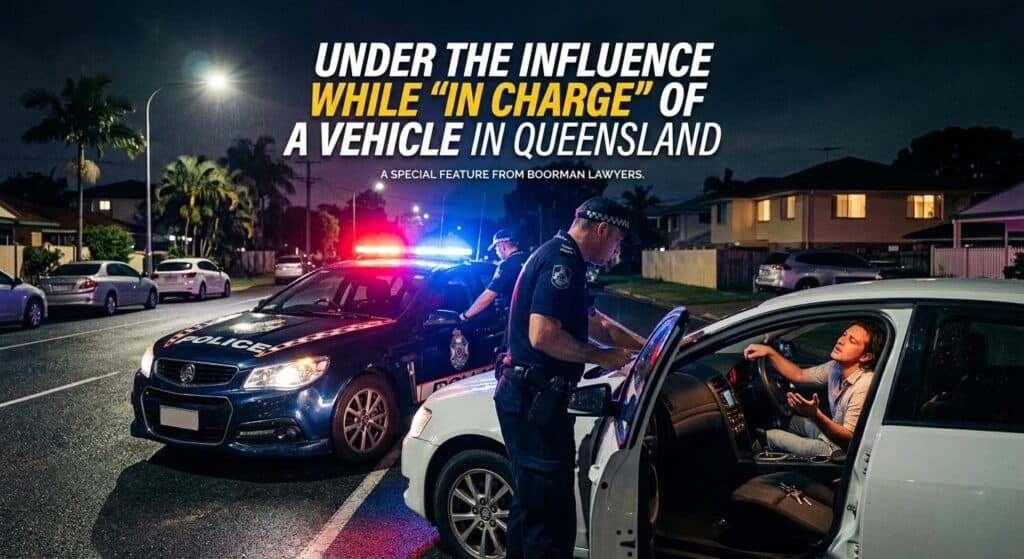
A practitioner guide to s 79(1)(c) of the Transport Operations (Road Use Management) Act 1995 (Qld)
Current to 21 August 2026 · Practitioner research resource · General information only
Executive summary
Queensland’s “in charge” alcohol offence is broader than ordinary drink driving. A person does not have to be seen driving, attempting to start the vehicle, or even intending to drive. The prosecution may succeed if, while under the influence, the person remains legally responsible for or in control of a motor vehicle.
The central provision is s 79(1)(c) of the Transport Operations (Road Use Management) Act 1995 (Qld) (“TORUM”). Section 124(1)(k) creates an evidentiary presumption of charge where a person appears, acts or behaves as the driver, or as a person having possession, custody, care or management of the vehicle. The presumption can be rebutted, but rebutting it does not automatically end the prosecution case: the court must still determine the substantive question of who was in charge.
The leading Queensland authorities demonstrate four recurring principles. First, a lack of intention to drive is generally not enough: Brooks v Spasovski [2004] QDC 471. Secondly, an inoperable or damaged vehicle can still have a person “in charge”: Kunze v Vowles; Ex parte Vowles [1955] St R Qd 591. Thirdly, the statutory “sleeping it off” protection in s 79(6) is real but technical and must be proved by sworn evidence beyond reasonable doubt. Fourthly, genuine transfer of responsibility to another person can matter: Wynne v Campbell; Ex parte Campbell [1965] QWN 7.
For practitioners, the case is usually won or lost on a precise factual chronology: who drove the vehicle to the location, where the keys were, whether responsibility had passed to another person, where the accused was physically located, whether the vehicle was safely parked, when alcohol was consumed, and whether the accused can satisfy every requirement of s 79(6).
1. The offence: s 79(1)(c)
Section 79(1) creates three related UIL offences: driving while under the influence, attempting to put a vehicle in motion while under the influence, and being in charge of a vehicle while under the influence. The “in charge” limb is s 79(1)(c).
For an ordinary motor vehicle prosecution, the prosecution must prove beyond reasonable doubt that, at the material time:
- the defendant was the person charged;
- the relevant object was a motor vehicle;
- the defendant was under the influence of liquor or a drug; and
- the defendant was in charge of that motor vehicle.
Section 79(11) is deliberately broad: the motor vehicle may be on a road “or elsewhere”. The offence is therefore not confined to public roads.
The maximum penalty for s 79(1) is 28 penalty units or nine months imprisonment. For a first s 79(1) conviction where there is no relevant conviction in the preceding five years, s 86(1) provides a six-month licence disqualification by operation of law. Prior relevant convictions can increase the disqualification period.
A restricted work licence is not available where the disqualification results from a conviction under s 79(1): s 87(5)(da). This is an important practical distinction between a UIL charge and many lower-range drink-driving charges.
2. What does “under the influence” mean?
The phrase “under the influence” is not simply another way of saying “over 0.05”. Historically, Queensland cases such as Noonan v Elson [1950] St R Qd 215 and O’Connor v Shaw [1958] Qd R 384 treat UIL as a state in which alcohol or drugs have materially affected the person’s ordinary faculties.
For alcohol cases, however, s 79(3) is decisive where the prosecution establishes that the defendant was over the high alcohol limit at the material time. The Act then conclusively presumes the defendant was under the influence of liquor. The current high alcohol limit is 0.150 g/210L of breath or 150 mg/100mL of blood.
Below that threshold, the prosecution may rely upon a combination of breath or blood evidence, observations of speech, balance, comprehension, smell of liquor, coordination, admissions and surrounding conduct. Practitioners should distinguish carefully between evidence proving intoxication at the time of testing and evidence proving UIL at the material time of the alleged in-charge conduct.
A practical point follows: where the reading is at or above 0.150 and the statutory certificate applies to the material time, arguments about whether the defendant “looked drunk” are unlikely to carry much weight because the statutory presumption is conclusive.
3. The concept of “in charge” is broader than driving
The most important conceptual point is that “in charge” is not synonymous with “driving”, “about to drive”, or “intending to drive”.
Queensland authority gives the expression a broad, responsibility-based meaning. The question is essentially who had responsibility, possession, custody, care, management or practical control of the vehicle at the relevant time.
This is why apparently sympathetic facts do not necessarily create a defence. A person may be asleep, have arranged a lift, have no present intention to drive, or be unable to drive the vehicle because it is damaged or out of fuel, yet remain legally in charge.
The safest way to analyse the issue is to ask two separate questions:
- Does s 124(1)(k) raise a presumption that this person was in charge?
- Even if that presumption is rebutted, does the evidence nevertheless establish substantive charge under the case law?
Those questions should never be collapsed into one.
“In charge” asks who retained responsibility for the vehicle — not simply who intended to drive it next.
4. Section 124(1)(k): the statutory presumption
Section 124 is headed “Facilitation of proof”. Section 124(1)(k) provides, in substance, that a person who appears, acts or behaves as the driver, or as the person having possession, custody, care or management of a vehicle, is presumed to be the person in charge.
This is an evidentiary presumption, not an irrebuttable definition. Wynne v Campbell; Ex parte Campbell and Brooks v Spasovski recognise that the presumption can be displaced by evidence.
That matters, but only to a point. In Brooks, the District Court accepted that the statutory presumption was not the end of the inquiry. The court then considered the substantive meaning of “in charge” and still concluded that the defendant was in charge.
Accordingly, a defence submission should not stop at “the presumption has been rebutted”. The defence must identify the evidence showing why another person had responsibility for the vehicle, or why the defendant lacked the relevant relationship of responsibility or control.
5. Brooks v Spasovski: no intention to drive is not enough
Brooks v Spasovski [2004] QDC 471 is the modern Queensland authority practitioners should read first.
“That he had no intention of driving it is in my opinion on the authorities irrelevant.”
— Brooks v Spasovski [2004] QDC 471
The defendant had consumed a large amount of alcohol. He had telephoned family members to collect him and had previously used family members in similar situations. He ultimately went to his vehicle, occupied the driver’s seat and fell asleep. The Magistrate acquitted him.
On appeal, McGill DCJ overturned the acquittal and convicted him. The case is commonly summarised by the proposition that the “absence of intention to drive [is] irrelevant” to the question whether a person is in charge.
The decision is especially important because it separates moral common sense from the statutory concept. A person may have acted responsibly in deciding not to drive and may genuinely intend to wait for another person, yet remain legally in charge until responsibility has actually passed to someone else.
Brooks also considered and distinguished Wynne. It treated Kunze as binding Queensland authority despite acknowledging the breadth of that earlier decision.
Practical consequence: “I was waiting for a lift”, “I had decided not to drive” and “I was sleeping it off” are not, by themselves, defences to s 79(1)(c).
6. Kunze v Vowles: an inoperable vehicle can still be in charge
Kunze v Vowles; Ex parte Vowles [1955] St R Qd 591 is particularly important where the vehicle is broken down, damaged, bogged, disabled or out of fuel.
Kunze had driven a vehicle which was involved in a collision. The vehicle was incapable of being driven and required towing. By the time police dealt with him, Kunze was approximately 60 yards away from it.
The Full Court nevertheless held that he remained in charge. The significance of the case is not merely physical proximity. Kunze had driven the vehicle to the place where it came to rest and there was no evidence that responsibility for it had been handed to another person.
Brooks later observed that Kunze was “ripe for overriding”, but McGill DCJ considered himself bound by it because it had not been overruled.
Practical consequence: the proposition “the car could not move, therefore I was not in charge” is legally weak. Mechanical impossibility may be relevant context, but it does not by itself break the chain of charge.
7. Wynne v Campbell: when another person is actually in charge
Wynne v Campbell; Ex parte Campbell [1965] QWN 7 provides the important counterpoint.
Wynne was a passenger, not the driver. The vehicle had been driven by another person. That driver left the vehicle to seek assistance after a mechanical problem. Wynne was later found in the front area of the vehicle.
The Full Court held that Wynne was not in charge. The key idea is that the actual driver had retained responsibility and had never transferred charge to Wynne.
The case therefore assists where the evidence identifies another person as the true person in charge. It is not strong assistance to a person who drove the car to the location, retained the keys and remained responsible for what happened to it.
Practical consequence: a genuine transfer of responsibility can be decisive, but the evidence should identify who assumed responsibility, when that occurred, and what objectively changed.
8. Eggmolesse v Bruce: physical interaction does not always equal charge
Eggmolesse v Bruce [2008] QCA 393; [2009] 1 Qd R 324 is useful because it demonstrates that physical interaction with a vehicle is not necessarily the same thing as being in charge.
The case involved an intoxicated mechanic who attended a broken-down vehicle to assist. His involvement with the vehicle was mechanical rather than an assumption of responsibility as driver. The Court of Appeal held that the circumstances did not make him the person in charge.
The case is fact-sensitive. It is most useful where the accused’s connection to the vehicle is temporary, technical or incidental and another person remains responsible for it.
9. The statutory protection in s 79(6)
Section 79(6) is the principal statutory protection for a person who deliberately refrains from driving.
It is unusual because the defendant must establish the required facts by evidence on oath beyond reasonable doubt. If every requirement is established, the court must not convict.
For a person inside the vehicle, the statutory pathway requires the defendant to have manifested an intention to refrain from driving by occupying a compartment other than the compartment containing the driving seat. For a person outside the vehicle, the intention may be manifested by some action.
The defendant must also establish:
- that they were not so affected as to be incapable of understanding what they were doing or forming the intention not to drive;
- that the vehicle was parked so as not to constitute a source of danger to other persons or traffic; and
- that they had no relevant conviction within the preceding year.
Each requirement matters. Failure on one limb defeats the statutory protection.
10. Newburn v McCann and Queensland Police Service v Murray
Newburn v McCann; Ex parte McCann [1970] QWN 17 is the foundation for the modern understanding of the compartment requirement.
“It is possible to be partly in one compartment and partly in another and thus to occupy two compartments at the same time.”
— Newburn v McCann; Ex parte McCann [1970] QWN 17
The Full Court recognised that a person can physically occupy more than one compartment at the same time. The question is not simply whether some part of the body remains over the driver’s seat. What matters is whether occupation of the other compartment objectively manifests the inward intention not to drive.
Queensland Police Service v Murray [2021] QMC 5 applied Newburn. Murray was found on a fully reclined driver’s seat with his body extending into the rear compartment. His vehicle was running when police arrived, but the Magistrate accepted evidence that he had activated the vehicle to operate the window and then returned to his sleeping position.
The Magistrate held that s 79(6) was established and dismissed the charge.
Murray is valuable, but it should not be overstated. It did not hold that sleeping in the driver’s seat automatically creates a defence. Its reasoning depended upon the particular reclined position, occupation of the rear compartment, the defendant’s continuing intention not to drive, capacity to form that intention, safe parking, and the other statutory requirements.
11. Sleeping in the driver’s seat: a common trap
A defendant who says “I was only sleeping” may still have a serious problem.
Sleeping is evidence of present inactivity. It is not necessarily evidence that legal charge has ended. Brooks is a direct warning against treating sleep or a decision not to drive as a complete answer.
The s 79(6) protection is also highly technical. A person simply asleep upright in the driver’s seat is ordinarily in a much weaker position than a person who has moved to the rear seat or otherwise clearly occupied a non-driving compartment in a way that manifests the intention not to drive.
Practitioners should obtain precise evidence about:
- whether the seat was upright or fully reclined;
- where the defendant’s head, torso and legs were;
- whether any part of the body occupied the rear compartment;
- why the defendant was in that position;
- where the keys were;
- whether the engine was operating and why; and
- what objective conduct showed an intention not to drive.
12. Keys: important evidence, but rarely decisive by themselves
The location of keys is often treated as if it answers the case. It usually does not.
Keys in the ignition are powerful evidence of control. Keys in a pocket may also support the inference that the person retained responsibility and the practical ability to use the vehicle. Handing keys to another person may assist, particularly where it accompanies a genuine transfer of responsibility.
But the case law is broader than a “who has the keys?” test. Wynne demonstrates that a person can be physically close to the controls without being the person in charge, while Brooks demonstrates that an intention not to use the keys does not necessarily end charge.
The correct question remains the total relationship of responsibility, custody, care and management.
13. Broken-down, damaged or out-of-fuel vehicles
Mechanical incapacity should be investigated carefully but not confused with a complete defence.
Section 124(1)(k) itself says, in relation to the statutory presumption, that impossibility caused by circumstances not known to the person is immaterial. More importantly, Kunze establishes at common law that an undriveable vehicle can still have a person in charge.
The better defence question is therefore not “could the car move?” but “had responsibility for the car passed to someone else before the defendant became UIL?”
Relevant evidence may include:
- arrival of roadside assistance;
- surrender of the keys;
- a tow operator taking control;
- another licensed driver assuming responsibility;
- police or transport officers formally taking charge of the vehicle; or
- objective arrangements showing the defendant had ceased to manage the vehicle.
Merely intending to call someone later, or merely waiting for assistance, may not be enough.
14. Post-driving drinking: why Davies-style arguments often fail in an in-charge case
A frequent argument is: “I drove sober, stopped, and only then consumed alcohol.”
“I would confine Davies … to those cases where there was no drinking prior to the offence.”
— Police v McCagh [2009] QMC 006 at [36]
That argument can be important in a prosecution for driving UIL because the prosecution must prove UIL at the time of driving. Cases considering post-driving drinking, including the line of authority discussed in Police v McCagh [2009] QMC 006, focus on the meaning of “material time” and the evidentiary effect of breath-analysis certificates.
For an in-charge prosecution, however, the analysis is different. Even if the defendant drove sober, the prosecution may still succeed if the defendant later became UIL while remaining legally in charge of the stationary vehicle.
McCagh also illustrates a credibility danger. A later claim of post-driving drinking may be rejected where it is inconsistent with contemporaneous statements to police. If a post-driving consumption case is contemplated, practitioners should obtain the body-worn camera, exact questions and answers, purchase records, receipts, CCTV, phone data and any independent witness evidence before advising on prospects.
Practical consequence: post-driving drinking is not a free-standing defence to s 79(1)(c). It only assists if the defendant was no longer in charge by the time they became UIL, or if it otherwise creates a genuine material-time issue.
15. Mistake of fact and other general criminal defences
Section 79(12) expressly provides that Criminal Code s 24 does not apply to offences under s 79. An honest and reasonable mistake of fact is therefore not available in the ordinary way.
Practitioners should be cautious about importing general criminal-law concepts into this statutory regime without checking the Act. The offence is heavily structured by specific presumptions, certificate provisions and the special s 79(6) protection.
16. Defences and arguments that can genuinely succeed
The following are potentially viable, depending on the evidence:
- The prosecution cannot prove UIL at the material time. This may arise where the statutory high-limit presumption does not apply and the evidence of impairment at the material time is weak, unreliable or temporally remote.
- The defendant was not substantively in charge. The strongest version is where another identifiable person was actually responsible for the vehicle, as illustrated by Wynne, or where the accused’s interaction was incidental rather than managerial, as in Eggmolesse.
- Responsibility had genuinely been transferred before intoxication. Evidence should identify the person who assumed charge and the objective act by which responsibility changed.
- Section 79(6) is fully established. This requires sworn evidence beyond reasonable doubt on every statutory limb. The safest factual example is a person who has moved into a rear or other non-driving compartment, is capable of forming the intention not to drive, is safely parked, and has no relevant conviction within the previous year.
- A genuine evidentiary or certificate issue. The defence should examine the breath or blood evidence, the statutory time provisions, continuity, identification and the prosecution’s nominated material time. Technical objections should only be run where the legislation and evidence genuinely support them.
17. Arguments that sound attractive but are usually not defences
The following propositions frequently sound persuasive to clients but, standing alone, are generally insufficient:
- “I had no intention of driving.” — Brooks is directly adverse.
- “I was asleep.” — sleep does not necessarily end charge.
- “I was waiting for someone to collect me.” — an intention to transfer responsibility later is not the same as an actual transfer.
- “The keys were not in the ignition.” — relevant, but not decisive.
- “The car was broken down.” — Kunze is directly adverse to incapacity alone.
- “The car had run out of fuel.” — same problem; inability to move is not necessarily loss of charge.
- “I only drank after I stopped driving.” — may answer a driving allegation, but not an in-charge allegation if charge continued.
- “I was doing the responsible thing by sleeping it off.” — morally relevant and potentially powerful on sentence, but liability still turns on s 79(6) and the meaning of charge.
- “Police did not see me drive.” — actual driving is not an element of s 79(1)(c).
18. Investigation checklist for solicitors
A competent early investigation should establish a minute-by-minute chronology wherever possible.
Ask and verify:
- Who drove the vehicle to the location?
- What time did the vehicle arrive or stop?
- Why did it stop?
- When did the defendant first become aware it could not be driven?
- When and where was alcohol purchased?
- Was any alcohol consumed before driving?
- Was alcohol consumed after stopping? How much and when?
- Where exactly was the defendant found?
- What was the seat position?
- Where were the keys?
- Was the engine running? If so, why?
- Had roadside assistance, police, TMR, a tow operator, family member or another driver arrived?
- Had anyone actually taken responsibility for the vehicle?
- Was the vehicle safely parked?
- What did the defendant say on body-worn camera?
- Are there admissions inconsistent with a later post-driving consumption account?
- Is there bank, CCTV, phone, location or call-log evidence capable of independently fixing times?
- Is s 79(6) genuinely available, and can every limb be proved by sworn evidence beyond reasonable doubt?
19. Defended hearing strategy
A defended s 79(1)(c) hearing should be narrow and evidence-driven.
The defence should usually:
- identify the prosecution’s alleged material time;
- require proof of UIL and charge at that time;
- distinguish direct observation from assumption;
- test who actually had responsibility for the vehicle;
- avoid arguing that intention alone determines charge;
- avoid arguing that mechanical incapacity alone determines charge;
- decide carefully whether the defendant should give evidence;
- anticipate prior inconsistent statements and body-worn-camera evidence;
- only run s 79(6) where the sworn evidence can satisfy every element; and
- acknowledge adverse authorities rather than attempting to disguise them.
Credibility with the Magistrate matters. A restrained submission that accepts Brooks and Kunze but identifies a genuine factual distinction is much stronger than attempting to turn sympathetic comments in those cases into a rule they did not establish.
20. Guilty plea and sentencing considerations
Some cases are legally difficult to defend but factually unusual. The “in charge” nature of the offence can be highly relevant to sentence even where it does not create a defence.
Mitigating features may include:
- no actual UIL driving proved;
- the vehicle was safely stationary;
- the vehicle was mechanically incapable of being driven;
- a genuine decision had been made not to drive;
- steps were being taken to arrange collection or towing;
- no prior alcohol-related offences;
- a good traffic and criminal history;
- early rehabilitation, traffic-offender education and abstinence or counselling where relevant;
- significant pre-sentence licence suspension; and
- demonstrated insight into why the law still regarded the defendant as in charge.
For a first s 79(1) conviction with no relevant conviction in the preceding five years, s 86(1) provides a six-month licence disqualification. The court also retains its ordinary sentencing discretion as to penalty and whether a conviction is recorded, subject to the Penalties and Sentences Act 1992 (Qld).
A restricted work licence is expressly unavailable for a disqualification resulting from s 79(1): s 87(5)(da).
22. Practical decision tree
Use the following sequence when assessing a new brief:
STEP 1 — Is the allegation actually s 79(1)(c)? Confirm the complaint. Do not analyse an in-charge case as though it were a driving charge.
STEP 2 — Can the prosecution prove UIL at the material time? If the reading is at or above 0.150 and applies to the material time, s 79(3) creates a conclusive presumption.
STEP 3 — Who was substantively in charge? Identify the person with responsibility, possession, custody, care or management. Apply s 124(1)(k), but remember it is rebuttable.
STEP 4 — Had charge passed to somebody else? If yes, obtain objective evidence of who, when and how.
STEP 5 — Is the defence relying only on lack of intention or vehicle incapacity? If yes, Brooks and Kunze are major obstacles.
STEP 6 — Does s 79(6) genuinely apply? Test every statutory limb separately. Do not assume “sleeping it off” is enough.
STEP 7 — Is there a post-driving drinking argument? Ask whether charge continued after driving stopped. If it did, the argument may not answer s 79(1)(c).
STEP 8 — Is a defended hearing proportionate? Compare the available evidence against the binding and persuasive authorities before advising the client on prospects.
STEP 9 — If liability is strong, shift the unusual facts to mitigation. Facts that do not amount to a defence may still materially reduce moral culpability and support the minimum available disqualification and a restrained penalty.
23. Key takeaways
The safest short statement of Queensland law is this:
- “In charge” is broader than “driving”.
- Intention not to drive is relevant context but is not, by itself, a defence.
- An inoperable vehicle can still have a person in charge.
- Section 124(1)(k) creates a rebuttable evidentiary presumption, not the final legal answer.
- Actual transfer of responsibility to another person can matter.
- Section 79(6) is the principal statutory protection but it is technical and demanding.
- Sleeping in the driver’s seat is not automatically protected.
- Post-driving drinking may defeat a driving allegation yet leave an in-charge allegation intact.
- A first s 79(1) conviction ordinarily carries a six-month disqualification under s 86(1).
- A restricted work licence is not available for a s 79(1) conviction.
Quick authority matrix
| Authority | Key facts | Legal proposition | Practical use |
|---|---|---|---|
| Brooks v Spasovski [2004] QDC 471 | Defendant had arranged collection, occupied driver’s seat and slept. | No intention to drive does not itself negate being in charge. | Strongly adverse where accused remains responsible for vehicle. |
| Kunze v Vowles; Ex parte Vowles [1955] St R Qd 591 | Vehicle damaged and undriveable; defendant about 60 yards away. | A person may remain in charge of an undriveable vehicle until responsibility passes. | Strongly adverse to breakdown/out-of-fuel arguments. |
| Wynne v Campbell; Ex parte Campbell [1965] QWN 7 | Defendant was passenger; actual driver had left temporarily and retained responsibility. | s 124 presumption is rebuttable; actual responsibility matters. | Potentially favourable where another person is truly in charge. |
| Newburn v McCann; Ex parte McCann [1970] QWN 17 | Defendant asleep on fully reclined driver’s seat extending into another compartment. | A person may occupy two compartments; manifestation under s 79(6) is factual. | Favourable where facts genuinely satisfy s 79(6). |
| Queensland Police Service v Murray [2021] QMC 5 | Reclined driver’s seat; body extended rearward; vehicle running for comfort/window; defendant proved statutory facts. | s 79(6) can succeed even where person is otherwise ‘in charge’. | Useful but fact-specific and not binding on other Magistrates. |
| Eggmolesse v Bruce [2008] QCA 393; [2009] 1 Qd R 324 | Intoxicated mechanic interacted with a broken-down vehicle to assist. | Physical interaction with a vehicle does not automatically establish charge. | Useful where involvement is incidental/technical. |
| Police v McCagh [2009] QMC 006 | Post-driving drinking argument and breath-certificate issues. | Davies-style material-time arguments are narrow and credibility-sensitive. | Limited assistance in an in-charge case if charge continued after driving stopped. |
| Hayes v Wilson; Ex parte Hayes [1984] 2 Qd R 114 | Authority considering the concept of charge. | ‘In charge’ has been associated with practical capacity/responsibility for vehicle. | Contextual authority; read with Brooks and Kunze. |
References and primary sources
- Transport Operations (Road Use Management) Act 1995 (Qld), s 79 — source
- Transport Operations (Road Use Management) Act 1995 (Qld), s 79(3), s 79(6), s 79(11), s 79(12) — source
- Transport Operations (Road Use Management) Act 1995 (Qld), s 79A (alcohol limits) — source
- Transport Operations (Road Use Management) Act 1995 (Qld), s 79B (immediate suspension) — source
- Transport Operations (Road Use Management) Act 1995 (Qld), s 86 (disqualification) — source
- Transport Operations (Road Use Management) Act 1995 (Qld), s 87(5)(da) (restricted licence exclusion) — source
- Transport Operations (Road Use Management) Act 1995 (Qld), s 124(1)(k) (facilitation of proof) — source
- Brooks v Spasovski [2004] QDC 471; 25 Qld Lawyer Reps 256
- Kunze v Vowles; Ex parte Vowles [1955] St R Qd 591
- Wynne v Campbell; Ex parte Campbell [1965] QWN 7; (1966) 60 QJPR 27
- Newburn v McCann; Ex parte McCann [1970] QWN 17
- Queensland Police Service v Murray [2021] QMC 5 — source
- Eggmolesse v Bruce [2008] QCA 393; [2009] 1 Qd R 324
- Police v McCagh [2009] QMC 006
- Hayes v Wilson; Ex parte Hayes [1984] 2 Qd R 114
- Kieran Tranter, ‘The Challenges of Autonomous Motor Vehicles for Queensland Road and Criminal Laws’ (2016) 16(2) QUT Law Review 59 — source
Legislation references in this guide were checked against the current Queensland legislation reprint on 21 August 2026. Historical case citations should be checked against an authorised report or database before filing written submissions.
